
Tutorials
FPGA Throughput vs Latency: Budget the Whole Data Path
Published · Updated
Measure first-result delay and sustained rate separately
A pipeline can take 20 cycles to produce its first result and still accept a new input every cycle. Conversely, a short computation can have a large initiation interval because it reuses a resource. Latency answers when a particular transaction completes. Initiation interval answers how often new work can begin under the stated operating conditions.

For a stage accepting one item every II cycles at frequency f, f/II is an ideal acceptance-rate ceiling. It is not a measured application throughput. Data packing, interface pauses, framing, memory access and software service can all lower the delivered rate. Keep items, samples, beats and bytes distinct.
Start with acquisition and transport requirements.
Account for external interface timing separately.
Find the slowest stage before increasing clock frequency
Consider three stages with ideal rates of 50, 25 and 40 million items per second. Their serial pipeline cannot sustain more than 25 million items per second without changing the middle stage or the architecture. Doubling the clock of the first stage alone does not remove that bottleneck.
The worksheet accepts frequency, II, items per accepted operation and a declared latency for each stage. It reports the smallest ideal rate and the sum of declared no-queue delays. That delay sum excludes queueing, clock crossing and external transport unless you include them explicitly. It is not an end-to-end worst-case latency bound.
Keep resource assumptions explicit.
Validate with accepted-item counters and bounded stalls
Measure accepted input and output transactions over a defined interval after startup. Preserve packet sizes, stall duration, data units and reset conditions with the result. If a stage is often blocked, distinguish downstream backpressure from a computation bottleneck. A FIFO occupancy trace helps show where work accumulates.
Use average utilization only for an explicitly average estimate. For buffer safety and response deadlines, keep the maximum service interruption and recovery capacity. Export the stage budget with its assumptions before requesting a device change: replacing an FPGA does not resolve a slow host interface or a consumer that never releases a buffer.
Inspect the timing bottleneck.
The lowest stage rate limits the path: short sequence
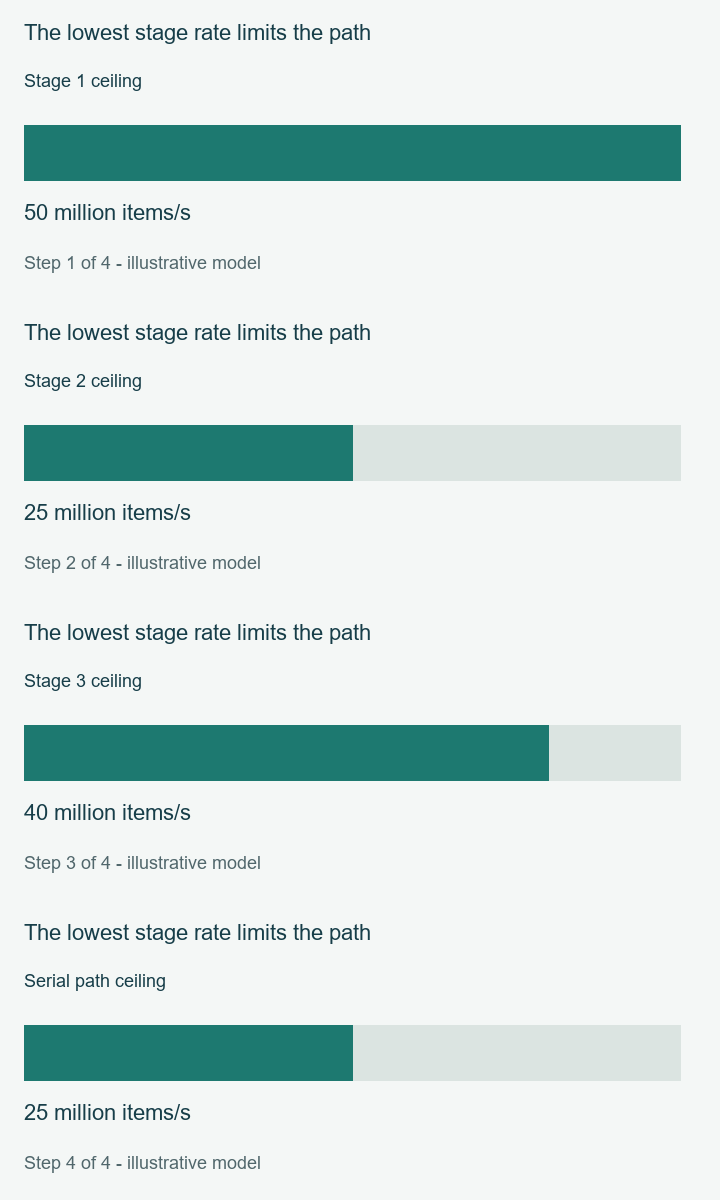
Stage 1 ceiling: 50 million items/s → Stage 2 ceiling: 25 million items/s → Stage 3 ceiling: 40 million items/s → Serial path ceiling: 25 million items/s
Export your result with its assumptions. For an unresolved board or implementation issue, prepare an engineering review with the exact part, revision and relevant record. This link opens the review page; it does not send your worksheet.
Sources and scope
Sources checked 18 November 2026. Numerical examples are calculated cases. Hardware measurements and device timing closure are outside the results shown here.
Back to Tutorials