
Tutorials
Ping-Pong vs Ring Buffers in FPGA Data Acquisition
Published · Updated
Choose the handoff unit before the memory structure
Ping-pong buffering makes a complete block the ownership unit: the producer fills one region while the consumer owns another. A ring tracks available and occupied space across a sequence of entries. Neither is automatically faster. The choice starts with whether the consumer needs an entire block, random access within that block, or a continuous stream.

For two equal ping-pong blocks of B entries and a producer rate R, one block fills in B/R. Once the other block is handed to the consumer, its worst-case processing and release time must fit before the producer needs that region again, unless the design supports a stall or drop policy. Average processing time is not the right bound.
Start from the acquisition workload.
Check pulse-event handshakes before changing ownership.
Treat ownership as state, not a changing address bit
Use explicit empty, filling, ready and consuming states, with a defined acknowledgment when a region becomes reusable. A producer that toggles a bank bit regardless of consumer progress can overwrite a block still being read. Reset must establish ownership on both sides, and a clock-domain crossing needs a proper handshake.
For a ring, define how full differs from empty. Reserving one entry is one possible convention; a count or extra wrap state is another. The Linux circular-buffer documentation is useful for understanding head and tail, but its software memory-ordering operations are not an RTL CDC solution. A processor-facing design also needs its platform-specific cache and DMA ownership rules.
Budget physical memory organization.
Compare the worst service gap, then decide
With 1,024-entry blocks and a producer delivering 10 million entries per second, a block fills in 102.4 microseconds. A worst-case release time of 150 microseconds cannot sustain the simple alternating two-block schedule without another policy. The worksheet exposes that timing conflict rather than calling either structure universally better.
A larger ring can absorb a bounded interruption, but it cannot fix a permanently slower consumer. Record usable capacity, maximum service gap, minimum recovery rate and what happens at full. Export those constraints before selecting memory or requesting a board review. Include metadata and alignment in the byte budget; payload entries alone are not the complete allocation.
Two-block release deadline: short sequence
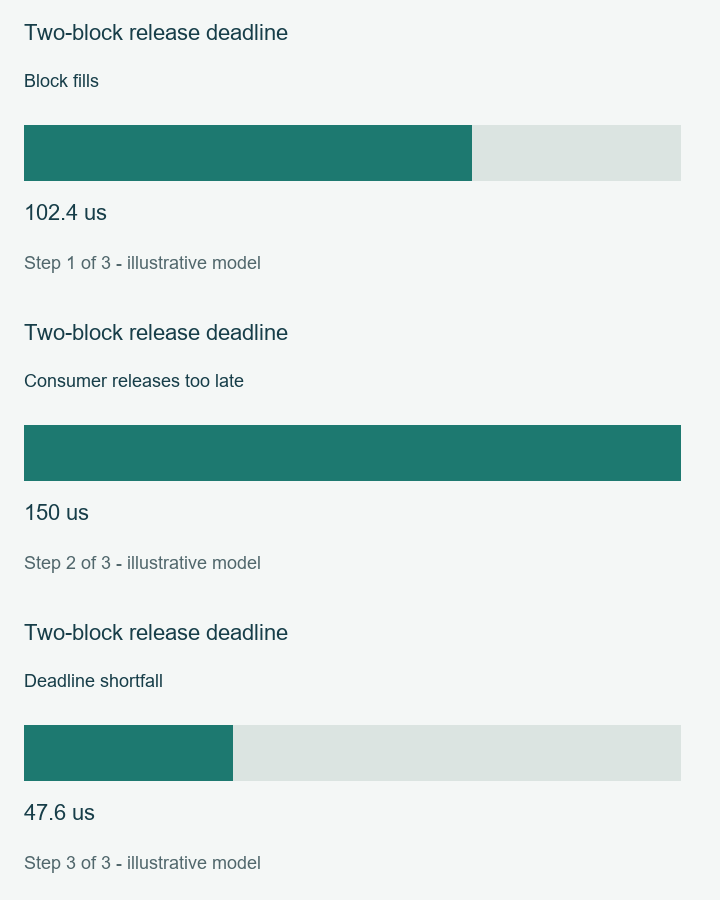
Block fills: 102.4 us → Consumer releases too late: 150 us → Deadline shortfall: 47.6 us
Export your result with its assumptions. For an unresolved board or implementation issue, prepare an engineering review with the exact part, revision and relevant record. This link opens the review page; it does not send your worksheet.
Sources and scope
- Linux Circular Buffers
- AMD PG057 v13.2, 2017-10-04
- AMD UG1399 Pipelining Paradigm, 2026.2
- AMD UG1399 Dataflow Memory Channels, 2025.1
Sources checked 18 November 2026. Numerical examples are calculated cases. Hardware measurements and device timing closure are outside the results shown here.
Back to Tutorials