
Tutorials
FPGA Programming Release Checklist: What to Send to the Factory
Published · Updated
A file named final.mcs is not a factory programming job. The operator still needs to know which assembly it belongs to, what may be erased, which data must survive and what constitutes a passing board. Send those decisions with the artifact rather than expecting the factory to infer them.
Reject an ambiguous programming job


Start the handoff with the assembly revision, complete programmable-device identity, image release and consuming tool/job version. State the required connection and board power arrangement. A familiar connector name does not define every signal or reference-voltage requirement.
Identify the approved file separately from the procedure. A matching file digest establishes byte identity against the approved value; it does not establish that the target is correct or that the supplied job writes the right region.
Require the factory to report an unresolved mismatch before proceeding. The package should make the expected board and artifact clear enough that an operator can detect a substitution or stale file.
At acceptance, verify the running release; the file selected by an operator is only one part of the evidence.
Separate first programming from rework
An empty assembly and a returned assembly may need different jobs. Rework can contain serial data, calibration or a recovery image that must survive. Define those regions and their ownership explicitly instead of reusing a full-device erase procedure by habit.
Record how unique data is allocated and verified. A retry should not silently create a second identity or reuse another board's values. Link the identity record to the physical unit and preserve the history of failed attempts.
State the recovery path if an operation stops midway. The operator needs a controlled next step and a way to distinguish a completed write from a partly processed board. Do not let a final successful retry erase the earlier evidence.
Before releasing a station job, define the fixture connection including board orientation and reference voltage.
Package the files and acceptance rules
A practical package has separate locations for the manifest, released images, address map, programming procedure, acceptance criteria and per-unit results. The names are less important than their consistency. Every procedure reference should resolve to a file and version in the package or another controlled source.
Keep the memory map synchronized with the actual generation settings and programmer scope. AMD's configuration-memory programming guidance distinguishes operating on the file's required address space from operating on the entire device. The factory job must make that choice explicit.
Separate acceptance layers: correct artifact selected, required programming verification completed, independent boot observed, and defined application checks passed. A package can legitimately leave a test outside the factory's scope, but it must not label an unperformed test as passed.
release/
  manifest.json
  images/approved-image.mcs
  map/regions.csv
  procedure/programming-job.md
  acceptance/board-tests.md
  results/README.md
This example layout contains filenames only. The worksheet exports a manifest with the fields you enter and unresolved review findings. Add the actual controlled artifacts before sending a package; an exported manifest is not evidence that those files exist or match their recorded identities.
For the wider assembly handoff, use the manufacturing package and attach this programming-specific record.
Keep one traceable result per board
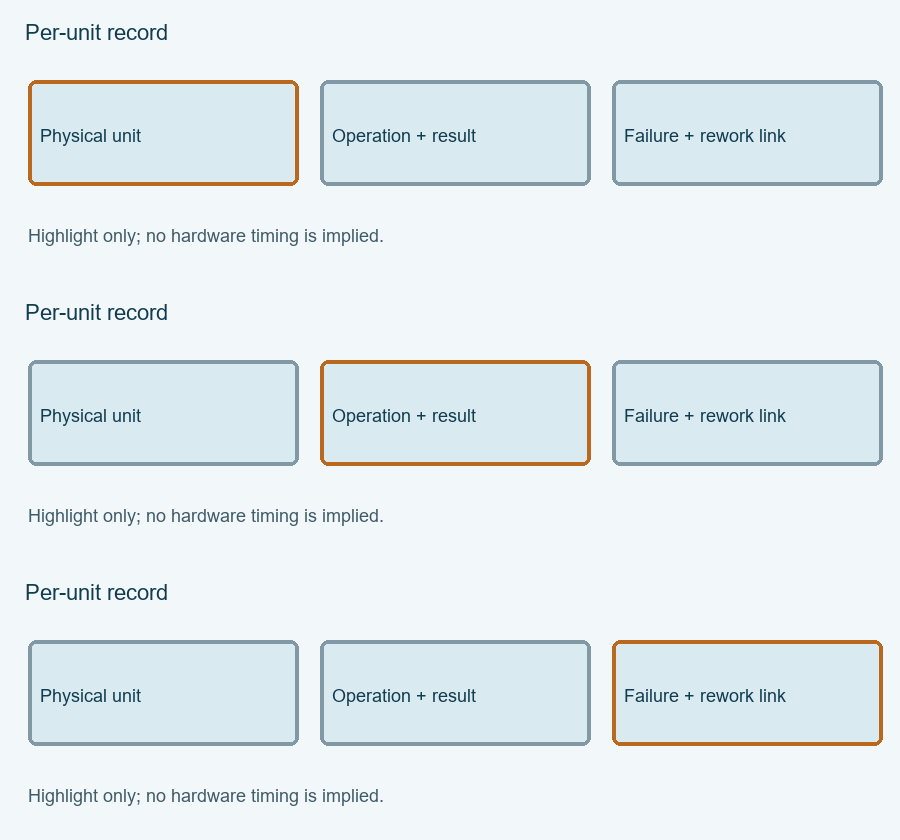
For each unit, retain board identity, assembly revision, image/job revisions, operation timestamp, operator or station identity and the required results. Store failures and rework links rather than keeping only the last green result.
Keep sensitive provisioning material outside a public example package. A template can define the field or reference without containing production secrets. Do not place real customer identifiers in a demonstration CSV.
Use the release worksheet to find missing fields and contradictions before the package leaves development. The manufacturing package tool covers the wider assembly handoff; the runtime bitstream verification article covers how to establish what design is actually responding. This page connects those activities to the factory's programming job.
After completing the worksheet, copy the job summary and unresolved items into an engineering enquiry. Opening the contact entry alone does not send the worksheet or approve a production run.
With the job requirements recorded, discuss assembly and programming scope and identify who performs each test.
Technical references for this scope: AMD UG908 2024.1 — Programming a Configuration Memory Device.
Highlight the three review items
Each highlight marks one item to review, not elapsed hardware time. The static figure contains the same information.
Enable JavaScript for the local Factory release-package validator. The article above provides the manual procedure; no data is submitted automatically.
Review and export your result before opening the engineering discussion entry. Attach the exported text yourself; opening the entry does not submit it.
Reference scope checked 15 November 2026. Calculations and conceptual diagrams describe the stated model. Commands and board behavior require validation in the actual tool and board environment.