
Tutorials
Verify Which FPGA Bitstream Is Actually Running
Published · Updated
A file hash, a successful programming log and a runtime build identifier answer different questions. The hash identifies a local file. The log records an operation against a selected target. A fresh runtime identifier connects an observation to the logic that is actually responding. Keep all three if you need to prove which FPGA release is running on a board.
This article builds a practical identity chain from a release manifest to a board observation. The worksheet compares entered hashes and build identifiers and flags missing evidence. It does not upload files, calculate hashes from your filesystem or read a connected FPGA. Its purpose is to prevent a filename from becoming an unsupported claim about the running design.
Open the diagnostic worksheet ↓
Create a build identity that survives copying and renaming

Give each released build a stable identifier and record it with the source revision, tool release, device target, relevant configuration choices and generated artifacts. Decide how the identifier is assigned before building. A timestamp can help organize outputs, but a timestamp alone may not uniquely describe sources, constraints and build settings. Keep the manifest explicit enough to reconstruct what the identifier means.
Associate the identifier with the implemented design, not only with a directory name. If the design exposes a readable build register or another diagnostic interface, make its value part of the build process and preserve the expected value in the manifest. Review how the value changes when a new build is created. A manually maintained constant that is forgotten during releases can make two different images report the same identity.
Choose an identifier format that the runtime interface can return without ambiguity. Record width, representation and byte order where applicable. If the interface returns several words, define their order and how the reader assembles them. A mismatch caused by formatting or endianness should be distinguishable from a genuinely different build. Do not silently normalize away differences that the release process treats as meaningful.
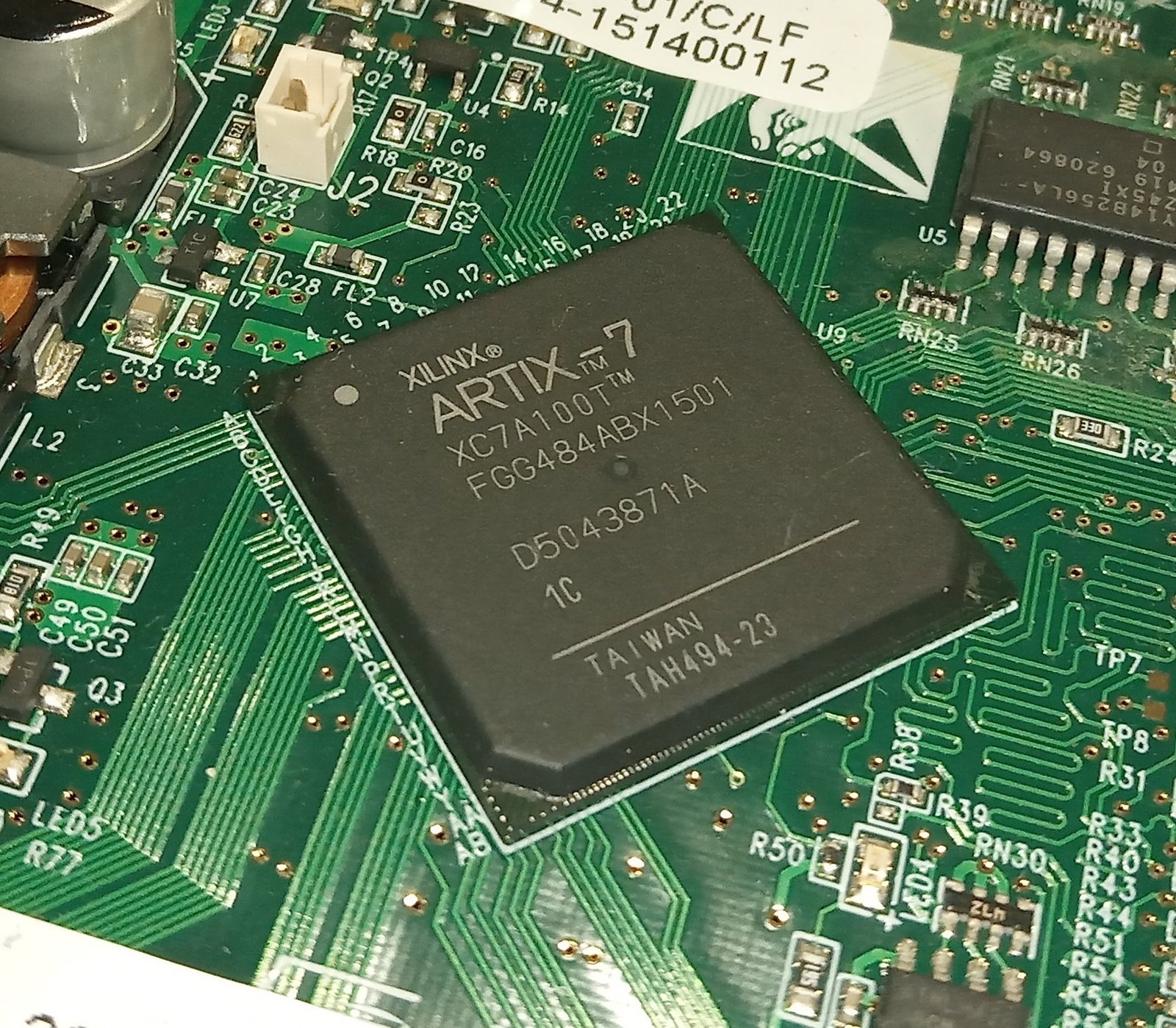
Keep the exact device and board requirements in the same manifest. The Artix-7 photograph shows an XC7A100T FGG484 package; it is not the XC7A100T-1CSG324C catalogue variant. A runtime build ID does not establish package compatibility or prove that the assembly uses the correct grade. Those remain separate manufacturing and configuration records.
Compute a cryptographic hash of the actual released programming file using a trusted local tool, and store the algorithm and full value. This article’s worksheet accepts SHA-256 values already computed by the operator. It compares the entered strings only. Do not describe that comparison as a fresh filesystem verification unless the file was actually hashed and the acquisition method was retained.
Distinguish artifacts produced for different purposes. A direct FPGA programming file and a boot-memory image can have different representations and hashes while deriving from the same design release. Record their relationship in the manifest rather than expecting byte-for-byte equality between unlike artifact formats. Keep the selected operation and selected artifact visible in the programming procedure.
Preserve the release package after publication or manufacturing use. Rebuilding into the same output path can replace a file while leaving its name unchanged. A retained manifest and immutable artifact copy make later comparisons possible. If a release is withdrawn or superseded, keep its historical identity so boards already programmed with it can still be recognized and handled correctly.
Link the selected file to the board and a fresh runtime read
Immediately before programming, inspect the file selected for the intended device and target. Do not rely solely on the project currently open in the IDE. An earlier hardware session or fixture profile can retain a different artifact path. Record the selected path, its freshly obtained hash, target identity and operation timestamp together.
Use the programming procedure documented for the installed tool release. AMD’s Vivado programming and debugging guide is the primary workflow reference; menu and property details must match the version in your record. This article does not claim that a command sequence was executed on a physical board during preparation. The evidence chain is independent of whether the operation was performed through the GUI or an established script.
Preserve the full programming result, including any retry or recovery. If the tool selected a different target after reconnecting, capture that change. A successful log without target identity is insufficient in a rack containing several similar boards. Use cable serial, chain position and board identifier to connect the operation to the physical unit.
After programming, obtain a fresh runtime build identifier through the design’s documented interface. Record how the value was read, when it was read and whether the interface can cache old data. If software displays a cached status value, refresh or perform the documented new transaction and preserve the result. A stale response can make an old image appear to be the new release.
Test the runtime identifier path itself. A constant returned by host software instead of FPGA logic, an address-map error or a disconnected diagnostic path can produce a plausible value. Use controlled development checks to establish that the interface changes when the intended build changes. Keep those validation results with the interface design rather than assuming that any matching text must have come from the FPGA.
When persistent boot is required, repeat the runtime identity observation after the specified independent startup procedure. Direct JTAG configuration can temporarily run a new image while boot memory still contains an older one. The Artix-7 flash-boot guide explains the separation between direct configuration, memory programming and independent boot. A warm session alone cannot establish the persistent path.
Configuration readback and verification provide another kind of evidence. AMD’s bitstream verify/readback section, checked as UG908 2026.1, describes verification with the corresponding mask and notes restrictions for encrypted images. Follow the supported flow for the device and security configuration. Do not treat a readback file as an ordinary byte-identical copy of every source artifact.
A runtime identifier is also not a complete functional test. It can establish that a particular diagnostic value is responding, while a data path or peripheral remains incorrect. Combine identity evidence with the application’s actual acceptance criteria. The PCB bring-up checklist provides the broader context for clock, reset, power and interface observations that a build ID alone cannot supply.
If the runtime interface is unavailable in a production image, document that limitation in the acceptance plan. Choose another supported identity observation and describe its coverage. Do not manufacture a runtime confirmation by copying the expected value from the manifest into the observed-value field. An unavailable observation should remain explicitly unavailable until a valid acquisition method exists.
Reconcile the evidence before releasing the board
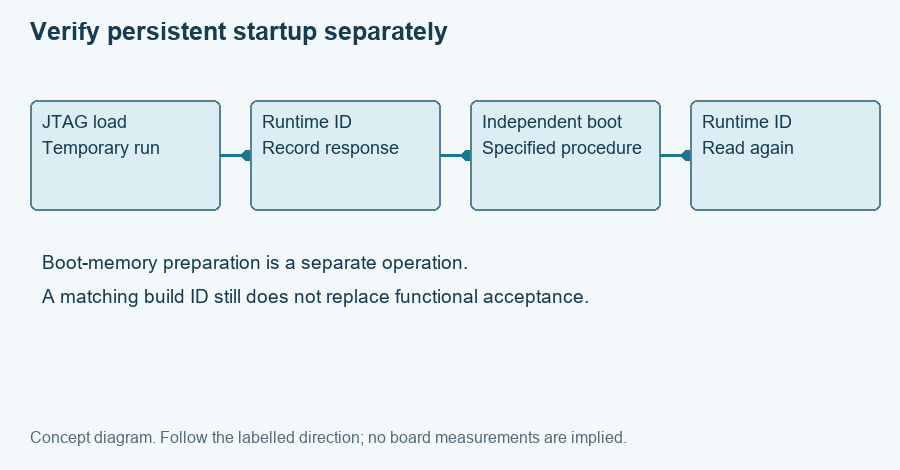
Show the diagram with each evidence item highlighted
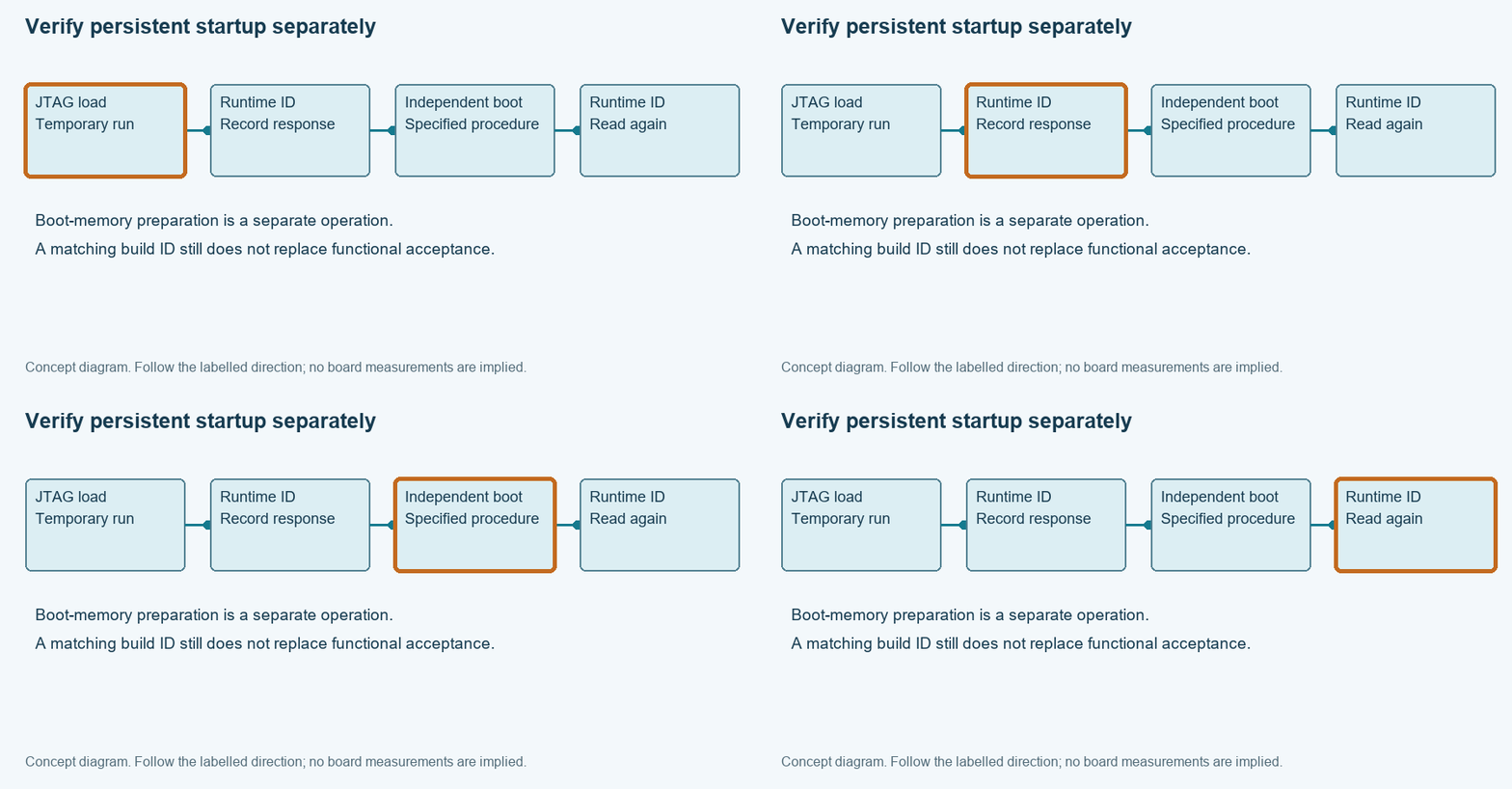
The highlight moves between the same four items. It does not represent elapsed hardware time. Close this disclosure to hide motion; the static diagram contains the same information.
Enter the expected and observed runtime identifiers, expected and selected-file SHA-256 values, programming-record status and independent-boot status. The worksheet compares identifiers exactly after trimming surrounding spaces. It normalizes hash letter case and requires exactly sixty-four hexadecimal digits for each supplied SHA-256 value. Missing values remain incomplete evidence rather than becoming implicit matches.
Read the output as several separate comparisons. A matching file hash supports the statement that the recorded file values agree. A matching runtime identifier supports the statement that the entered runtime text agrees with the expected identifier. Neither comparison proves how the values were acquired. Keep the hash command output and runtime transaction record with the exported report.
Consider a hypothetical case in which the selected file hash matches the release manifest, programming succeeds and the runtime ID still reports the old release. Investigate target identity, stale reads, actual file selection and the build-ID implementation before declaring the FPGA defective. The contradiction is valuable because it shows that the evidence chain is incomplete somewhere between file selection and observation.
In another hypothetical case, the new identifier appears immediately after JTAG programming but the old identifier returns after independent power-on. That pattern directs attention toward the persistent boot path or selected boot image. It does not automatically establish whether memory programming, boot addressing, image selection or another startup condition caused the result. Preserve both observations and investigate the first unproven transition.
Define release criteria in the fixture record. The programming fixture design article provides a structure for target identity, programming result, runtime observation and retained evidence. Require a fresh read at the relevant stage instead of accepting a cached value or a previously checked box. Store the fixture software revision as well as the FPGA image revision.
Keep failures visible when a board is reworked or reprogrammed. A final successful record should link to the earlier mismatch and corrective action, not erase them. This history helps distinguish a one-time selection error from a recurring release-package problem. It also makes it possible to identify other boards that may have passed through the same ambiguous process.
Without JavaScript, use a table with separate rows for file identity, selected target, programming operation, runtime identity and independent boot. Attach the acquisition evidence to each row. Do not collapse the table into one “verified” label until the project’s actual acceptance requirements have been reviewed.
For an engineering discussion, export the comparison and include the first point where expected and observed evidence diverge. The useful question is specific: the selected artifact differs, the runtime read is stale or ambiguous, or independent boot returns another image. That lets the reviewer follow the identity chain and design the next check without guessing what “the latest bitstream” means.
Enable JavaScript for the local worksheet, or use the manual record procedure in the article. No data is submitted automatically.
Use the record for the next engineering decision
Review and download the worksheet above. For board-level help, open the engineering scope entry and include the exact board revision, observed failure and unresolved check. For an exact-part enquiry, use the component quotation entry with the complete ordering code and quantity. Opening either entry does not submit a request.
Reference scope
Prepared for the specific diagnostic task shown above. Source checks: 2026-11-14. UG470 references use v1.17; cited UG908 task pages were checked as 2026.1 where stated. Hardware commands and board behavior require verification in the actual setup. Concept figures and hypothetical examples are not measured test results.