
Tutorials
False Path vs Multicycle Path: Prove the Exception Before Adding It
Published · Updated
A false path removes a timing check from the selected path. A multicycle constraint changes which clock edges define that check. Neither makes slow logic faster. Choose an exception only after the functional behavior explains why the default timing relationship is wrong.
Decide what the hardware actually does
Begin at the launch and capture registers. Can data launched here be captured there on the next active edge? If yes, the ordinary single-cycle requirement may be correct. “This block is usually idle” does not establish that it can never capture on an earlier edge.


The Zynq device photograph identifies a physical programmable device, but it says nothing about the validity of an exception. That proof comes from the RTL, operating modes and clock relationships. Review the failing path before changing its analysis.
| Functional situation | Candidate treatment |
|---|---|
| Path is used and must be captured next cycle | Keep the normal timing check. |
| Path is used, but the protocol guarantees later capture | Investigate a multicycle model with explicit edge proof. |
| Selected path is not a valid synchronous timing path | Investigate a narrowly scoped false-path or other appropriate constraint. |
| Relationship or enable behavior is unknown | Leave the exception unresolved and gather evidence. |
An asynchronous crossing still needs a safe structure. Cutting its timing relationship is not a substitute for a synchronizer or protocol.
Draw the capture edges for a multicycle path
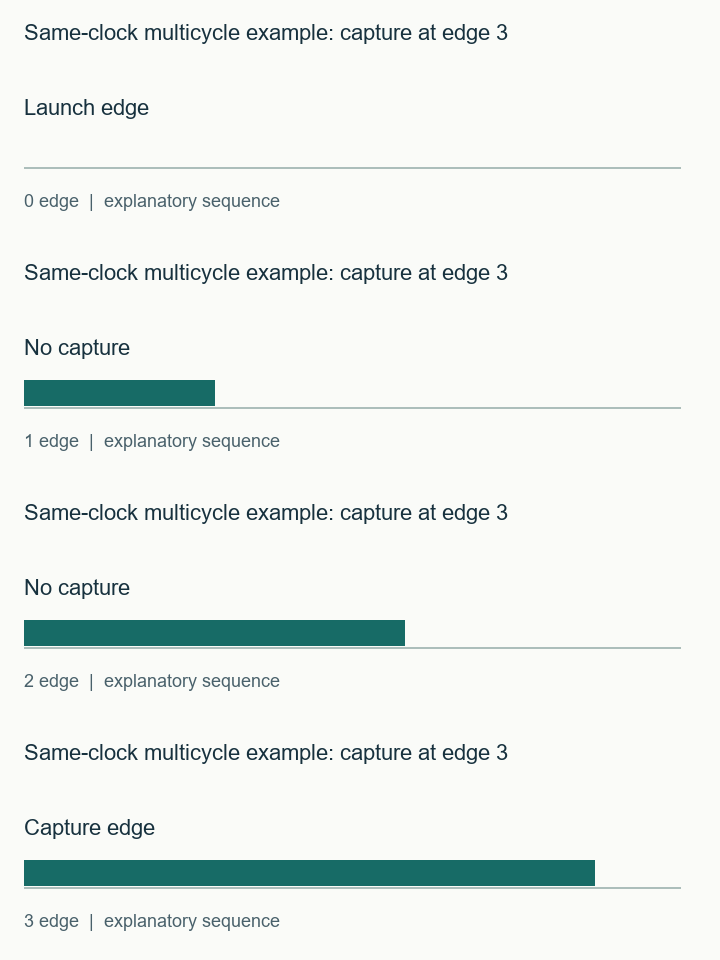
Consider one clock domain where the source launches at edge 0 and a verified enable schedule allows the destination to capture only at edge 3. Under that specific contract, a three-cycle setup relationship may describe the design. The source data must remain suitable for the intended capture; a source that changes on intervening edges can invalidate the argument.
The setup multiplier also affects the hold relationship. In the common same-clock case, a setup multiplier N is often paired with hold N−1 to restore the intended hold edge. That is not a universal recipe across different clock periods, phases or -start/-end choices. AMD UG903 supplies separate cases for those relationships. Read the before/after launch and capture edges in the timing report.
Avoid a copy-ready command with broad get_cells wildcards until you have checked the endpoint set. A hierarchy rename, register replication or an unintended extra match can change which paths are covered. Save the expanded object list and expected count with the exception review.
The edge diagram illustrates the selected same-clock case only. It does not authorize a multicycle constraint on every path with an enable signal. If the clock definition is wrong, fix the clock model first.
Prove the exception survived the implementation
report_exceptions -file exceptions.rpt
report_timing_summary -delay_type min_max -report_unconstrained \
  -check_timing_verbose -file timing-summary.rpt
Check which objects the exception matched, whether another exception superseded it and which setup/hold edges remain. Compare the full path report before and after the change. A timing summary that simply becomes green cannot establish whether the intended paths were relaxed or accidentally removed.
The decision worksheet records three facts: whether the path is functionally used, whether later capture is guaranteed and whether the edge relationship is known. It deliberately emits no wildcard XDC. Unknown answers produce a request for evidence, because syntax generation is not the difficult part of exception review.
Run the coverage audit again after every exception change. For an external interface, first complete the input/output timing budget so an exception does not conceal a missing interface model.
A useful review package contains the relevant RTL, the enable or mode proof, clock definitions, expanded endpoint lists and before/after setup and hold reports. Record the reason in the constraints file so a later refactor has something concrete to recheck.
Timing-exception evidence worksheet
Inputs and exported records stay in this browser. The check evaluates the assumptions you enter; it does not inspect your project files.
Use the worked values and equations above, or download the examples below. The interactive check requires JavaScript.
Watch the short same-clock multicycle example: capture at edge 3 sequence
The sequence visualizes the stated example. It is not a hardware capture. The static figures and text above contain the same explanation.
Export the decision record and attach the expanded endpoint lists plus before/after timing reports.
Download the timing and RTL examples (ZIP) · Discuss this engineering task
The ZIP includes the clock and I/O examples, timing-audit commands, counter/latch/reset RTL and testbenches. Bring the relevant exported record to the enquiry; this page does not submit it automatically.
References and example scope
Documentation checked 16 November 2026. AMD examples use the cited 2024.1 documentation baseline. Vivado commands and vendor macros were not executed for this article. Counter, latch and illustrative reset tests were executed with Icarus Verilog; latch structure was checked with Yosys. See the included commands and validation record for the exact scope.