
Tutorials
FPGA FIFO Depth Calculation for Bursts and Read Stalls
Published · Updated
Count entries actually offered to the queue
A 100 MHz clock does not automatically produce 100 million FIFO entries per second. Enables, accepted bus transfers and packet gaps determine the arrival rate. Start with entries rather than mixing samples, bytes and words. If one entry contains four samples, that conversion must be explicit on both sides.

A single average rate hides the problem that usually causes overflow: a finite interval when the consumer stops or slows down. Describe the workload as consecutive segments with duration, offered write rate and available read service. Include existing occupancy at the beginning. A consumer cannot remove entries that have not arrived; unused service during an empty interval cannot be saved for later.
See the AD7606 acquisition budget.
Separate interface voltage planning from queue sizing.
Find the peak across a complete service cycle
Take an initially empty FIFO. For 10 microseconds, arrivals are 20 entries per microsecond and service is 10; occupancy grows to 100. For the next 5 microseconds, arrivals remain 20 and service stops, taking occupancy to 200. A final 20-microsecond interval with arrivals of 5 and service of 20 drains the queue. The peak is 200 entries, even though the complete cycle can clear its backlog.
The segment worksheet tracks the continuous-rate model and reports the peak and its time. Append another complete cycle to test whether backlog accumulates between bursts. For discrete transfers, add a separately justified bound for phase and edge-order effects. Do not round a fluid estimate into a hardware guarantee without checking the actual interface semantics.
Translate capacity into BRAM organization.
Reserve room for data already on its way
If a producer can deliver eight more entries after a stop request, those entries need storage. State whether this allowance is already included in the traffic segments before adding it; counting the same pipeline twice makes the estimate misleading. Conversely, a safety percentage cannot replace an unknown maximum stop latency.
If arrivals permanently exceed service and the source cannot be stopped, no finite FIFO solves the rate mismatch. Change the service capacity, sampling policy or loss strategy. Keep the resulting depth separate from physical BRAM allocation, and test the chosen full/almost-full thresholds against the implementation.
Preserve implementation identity.
Example FIFO occupancy: short sequence
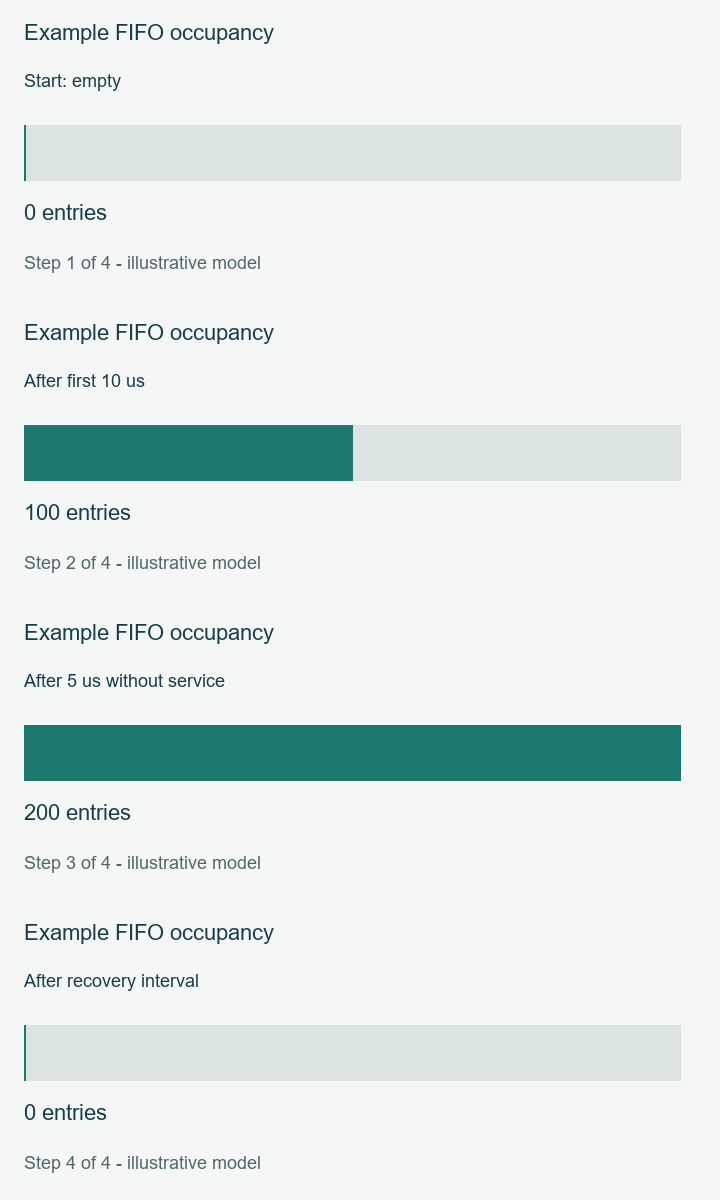
Start: empty: 0 entries → After first 10 us: 100 entries → After 5 us without service: 200 entries → After recovery interval: 0 entries
Export your result with its assumptions. For an unresolved board or implementation issue, prepare an engineering review with the exact part, revision and relevant record. This link opens the review page; it does not send your worksheet.
Sources and scope
Sources checked 18 November 2026. Numerical examples are calculated cases. Hardware measurements and device timing closure are outside the results shown here.
Back to Tutorials