
Industry Insights
Preparing a Traceable FPGA BOM for Component Quotations
Published · Updated
A useful quotation starts with a stable description of what you want to buy. For an FPGA project, that means more than a device-family name and a board quantity. The supplier needs complete ordering codes, the correct build revision, realistic quantity scenarios and a clear statement of which sourcing or manufacturing work is included. This guide explains how to turn a working engineering BOM into a quote-ready document without hiding unresolved design choices.
You will produce a line-item worksheet, a short evidence checklist and two different enquiry briefs: one for components, another for a complete board project. The numerical example is hypothetical. It does not describe available inventory, supplier pricing, a customer order or a verified manufacturing yield. AI-assisted editorial preparation does not replace approval by the people responsible for your design and purchasing decisions.
1. Preserve the identity of every requested component

Start by separating the manufacturer ordering number from every other identifier in your files. An internal stock code, a schematic value, a distributor SKU and a package marking may all be useful, but they serve different purposes. Put the complete manufacturer code in its own column and preserve its spelling. Keep the internal code in a separate column instead of replacing the manufacturer identity with it.
For example, the public XC7A100T-1CSG324C reference page is useful for checking the exact requested item and locating its supporting documents. Use it as an ordering-code example, not as a recommendation for every FPGA board. Before selecting it for a new design, the engineering review still needs the actual resource, package, electrical and tool constraints. A quotation request is not a shortcut around that review.
A family label such as “Artix-7” does not specify a complete purchase line. Equally, replacing a package or grade suffix because another listing looks cheaper changes the requested item. If an alternate is being considered, put it on a separate proposed-alternate line, name the person who must approve it, and describe the outstanding checks. Do not silently edit the released BOM while collecting prices.
Record the manufacturer document used to establish the code, its revision or retrieval date, and the applicable ordering table or package reference. The evidence should explain the identity actually being requested, rather than merely mentioning the same family. Where a document is ambiguous, write “ordering identity requires confirmation” and retain the original string. A visible uncertainty is easier to resolve than an apparently precise code assembled from guessed suffixes.
2. Tie the BOM to one board revision and one assembly variant

A purchasing spreadsheet can be internally tidy and still describe the wrong build. Add the board identifier, hardware revision, BOM revision, assembly variant and issue date to the quotation package. State whether the BOM is preliminary, released for quotation, or released for a particular build. Those states need not be identical: requesting a price does not make an unfinished design ready for assembly.
Reference designators connect the commercial line to the board. If a row says quantity two per board, identify the two placements or explain why that relationship does not apply. Separate board-level materials from loose accessories, test fixtures and optional spares. Otherwise, multiplying every row by the number of boards can generate a plausible but incorrect order quantity.
Keep do-not-populate components and assembly options explicit. A resistor fitted on one variant may be omitted on another, and an optional interface may require several components together. Do not assume a supplier can reconstruct the intended variant from a screenshot or a filename. Provide a short variant description and a single authoritative BOM for each requested build configuration.
Use the existing BOM completeness check to review tab-separated MPN, quantity and explicit reference columns. It can identify structural issues such as missing quantities or repeated references. It cannot prove that the schematic, footprint and assembly variant agree, or that a part is genuine or available. Read the tool's limitations and keep its output alongside the actual engineering review.
Before sending the package, compare the BOM revision with the placement data, assembly drawing and fabrication release. If a file still carries an older revision, resolve the difference or document the exception. The goal is not matching filenames for their own sake: the recipient must know which physical build the requested components belong to.
3. Separate per-board demand, build quantities and purchasing allowances
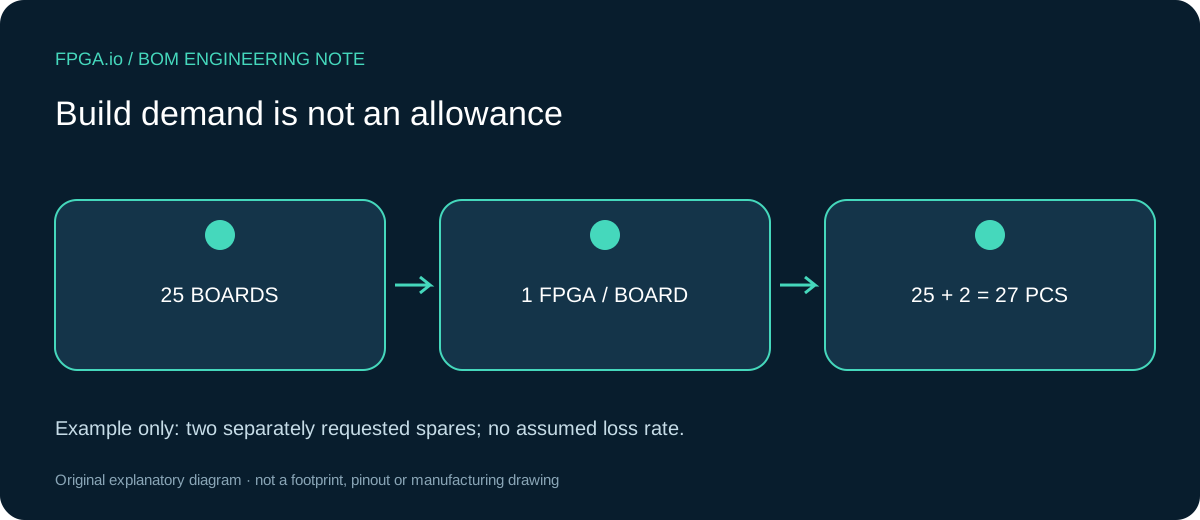
Quantity is often the first number a buyer enters and the first assumption that gets lost. Keep at least two fields distinct: the component count on one assembled board and the number of boards in the requested batch. Calculate the base component demand from those inputs. Then list any spares, setup allowance or service stock separately, with a reason and an owner.
Consider an illustrative project with twenty-five prototype boards and one FPGA per board. The base demand is twenty-five devices. If the project owner explicitly requests two additional devices for service or controlled rework, the enquiry quantity becomes twenty-seven. Those extra two devices are a purchasing decision in this example, not a recommended scrap rate or a prediction that two boards will fail.
For a second component used twice on each board, the same build requires fifty placements before any separately approved allowance. That does not mean every item should receive an identical percentage uplift. High-value programmable parts, low-cost passives and mechanically handled connectors may have different purchasing considerations. Agree them with the responsible people rather than hiding an arbitrary allowance inside a spreadsheet formula.
Ask for separate pricing at the quantities that represent real decisions: perhaps the prototype build, a pilot run and an explicitly nonbinding production forecast. Label the forecast as such. A forecast is not an order, and a price at a larger quantity is not automatically applicable to a smaller shipment. The response should make the quantity tier and any minimum-order or packing constraints visible.
Finally, distinguish component quantity from board quantity in a combined sourcing and PCBA enquiry. A field containing “25” is ambiguous unless it says devices, kits or assembled boards. Include units in the worksheet and in the request summary. If packing constraints change the purchasable quantity, ask the quotation to show both the required demand and the proposed supplied quantity, rather than assuming they are equal.
4. Specify the evidence you need before comparing offers

Traceability is not a decorative checkbox. Describe the records you need to evaluate a proposed supply route and explain any project-specific restrictions. Depending on the project, the review may ask about the legal seller, the proposed source, lot or date information, condition, packaging and the documentation supplied with the goods. Ask for evidence the supplier can actually provide; do not treat a generic assurance as a substitute for a defined record.
For manufacturer channel information, consult the current AMD Adaptive SoC and FPGA distributor page or the relevant manufacturer guidance, such as TI's authorized-distributor information. Manufacturer lists can change. A link to a manufacturer or distributor does not establish that FPGA.io has an authorized relationship with that company.
Keep authenticity, electrical suitability and assembly readiness as separate questions. A document supporting the source of a device does not prove that its package matches your PCB. A completed functional test on one board does not establish the history of every component. Similarly, an appearance photograph alone is not a complete authenticity assessment. Define the evidence and acceptance process appropriate to your actual procurement requirements.
Ask the supplier to identify any exceptions before the quotation is accepted. An offer for a different packing form, an alternative code or a split delivery may still deserve evaluation, but it should not be silently presented as an exact match. Record the exception, its impact and the approval needed. For an FPGA substitution, engineering review may extend to package pin assignments, supplies, configuration, timing constraints and the supported tool flow.
Use the XC7A200T-2FBG484C reference page only as an example of a separate complete ordering identity when comparing records. It is not a drop-in replacement recommendation for the earlier example. The useful lesson is to keep distinct candidates distinct and to preserve the qualification work required before any BOM change.
If an offer changes an ordering code or describes an unavailable item, use the exact-part and alternate-review workflow to assign that exception. Do not merge a supplier-proposed substitute into the original line merely to make the quote sheet look complete.
5. Compare quotations against the same requirement sheet
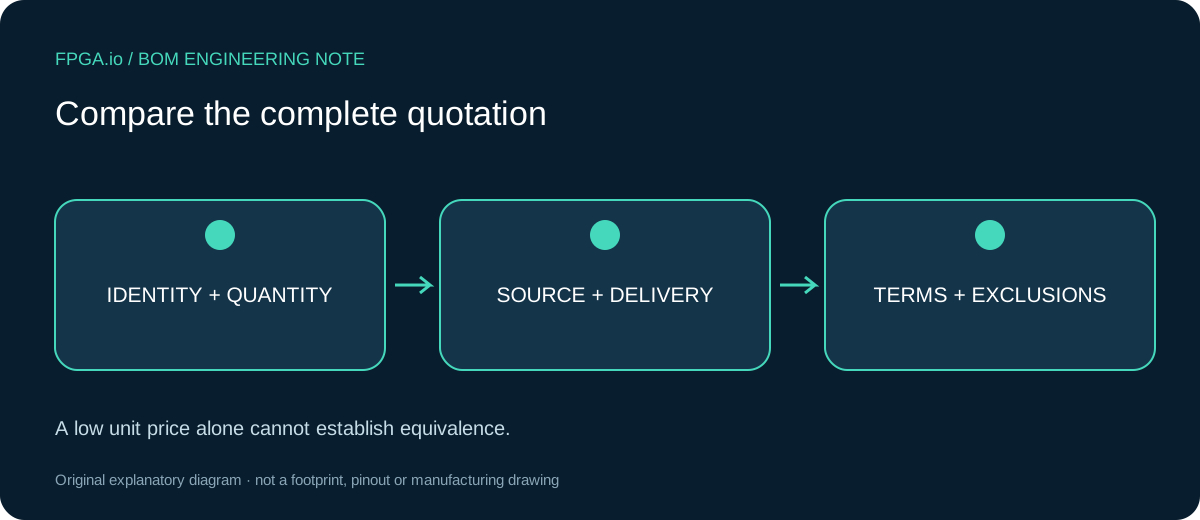
Once offers arrive, return to the requirement sheet instead of ranking only by unit price. Confirm the complete requested code, quoted quantity, currency, packing, stated availability, delivery basis and validity period. Record any exclusions or conditions directly beside the corresponding offer. A number copied out of an email without its conditions is not a comparable commercial result.
Separate a requested date from a confirmed commitment. The project may need parts by a particular day, but the supplier's response must explain what is being offered and on what basis. If the response describes an estimate or a dependency, keep that wording visible. Do not rewrite an estimated lead time into a guaranteed delivery date in the internal summary.
For split shipments, compare the impact on the build plan. Receiving a portion of one component line does not necessarily allow the same fraction of boards to be assembled. The build may be constrained by another part, programming preparation, a fixture or the availability of reviewed manufacturing files. A complete project discussion should identify that dependency rather than optimizing a single line in isolation.
Keep component-only and assembled-board quotations in separate comparisons unless their scopes have been normalized. A PCBA price may cover different combinations of sourcing, bare boards, assembly, inspection, programming and functional testing. Ask which activities and materials are included, who supplies the firmware or test procedure, and what constitutes acceptance. Do not infer those details from the phrase “turnkey.”
As an editorial planning method, use three dispositions for every unresolved point: acceptable as quoted, clarification required, or rejected against the requirement. Name the decision owner and retain the response. This creates a useful audit trail without pretending that a spreadsheet score can replace commercial judgement or engineering approval. The cheapest line can then be considered in context instead of becoming the automatic decision.
Use this browser-local arithmetic worksheet only after both offers describe the same requested item. Enter the actual values from the offers; the fields start empty. It compares declared line totals for equal quantities and currencies without converting currencies, adding an assumed loss rate or recommending a supplier. A calculated total does not close provenance, delivery, warranty or acceptance questions. Record those conditions separately.
Without JavaScript: quantity × unit price + declared freight + declared inspection cost. Compare equal quantities and currencies only; excluded taxes, duties and other charges remain explicit.
6. Send a component enquiry or a complete project brief

For a component-only request, prepare a compact summary containing the full MPN, quantity with units, required date, destination, traceability requirements and alternate policy. State whether you are seeking one firm batch or several quantity scenarios. If the design is not yet released, say so. Clear context helps avoid a quotation based on a level of certainty the project does not yet have.
For a board project, add the application, board reference and revision, expected build quantities, and the state of the design files. Separate the work you already own from the work you want reviewed: schematic or layout assistance, component sourcing, PCB fabrication, assembly, firmware loading, fixture development and functional testing are different scopes. The provider must confirm which requested activities are supported and which are excluded.
Include measurable acceptance criteria where they exist and identify the missing ones. “Test the board” is not a complete instruction. Explain the interfaces to exercise, the available test image, required records and the person responsible for approving the procedure. If those details are still being developed, request a scope review rather than representing the project as ready for production.
Use the buttons below to open Contact. Keep a copy of your requirements summary and paste it into the form, then check the selected service and quantity before submission. Do not assume an article link has transferred every detail. Mention the need for an NDA or a secure transfer route before sending confidential design files; the initial enquiry can describe the task without exposing the complete design.
The next useful outcome is a scoped response: the requested item or project, the information still needed, and a quotation with explicit conditions. Submission is not an order, and this article does not promise inventory, pricing, lead time or a certified design. If the project is still at the engineering-review stage, use the FPGA PCB bring-up checklist and the PCBA scope page to prepare the missing inputs first.
The request worksheet below preserves one full manufacturer order code and the component quantity. It produces a downloadable checklist and an editable Contact link. It does not inspect a private BOM, confirm an ordering identity or upload the downloaded record. Add the board revision, required delivery, destination and permissions privately after reviewing the prefilled inputs. If several lines are involved, retain each complete MPN separately in your controlled BOM and make clear which quantity belongs to each line.
Without JavaScript: write the exact MPN, component quantity and alternate permission, then copy the requirement into the private Contact form.
Bring your exact MPN or board reference, quantities, required date and review requirements.
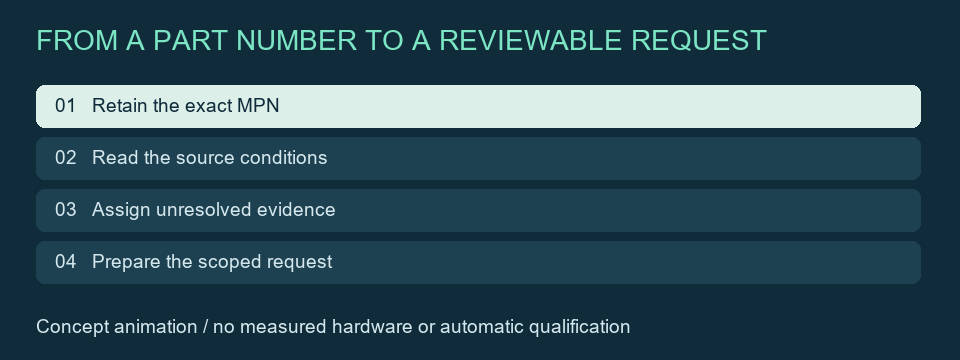
Open the animated steps; close to hide motion
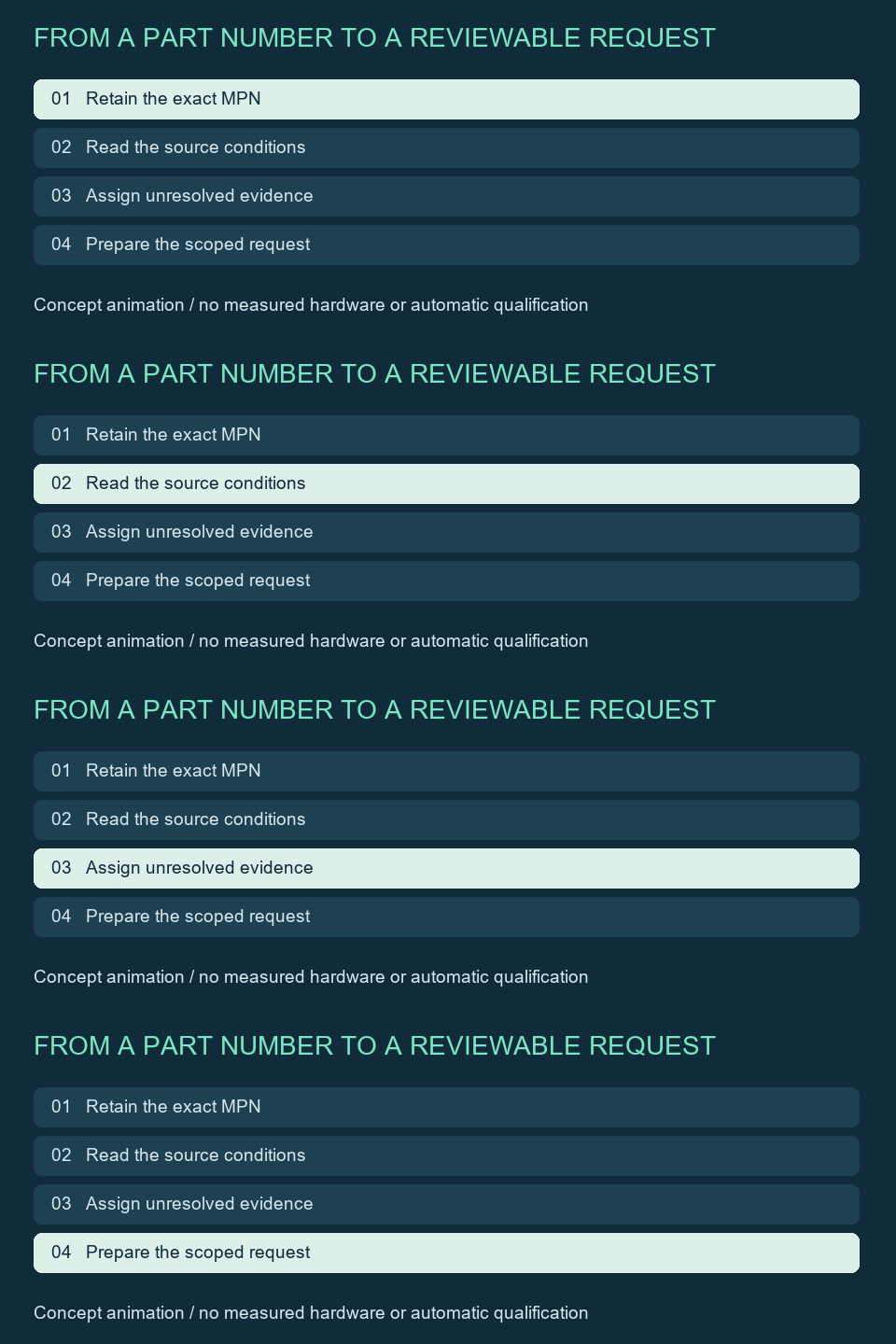
- Retain the exact manufacturer ordering code.
- Record the source revision and operating conditions.
- Assign unresolved evidence to its owner.
- Prepare an exact request or separately authorized change review.