
Industry Insights
When EP4CE10E22I7N Is Unavailable: A Controlled Alternate Review
Published · Updated
If a supplier cannot offer EP4CE10E22I7N for your required date, the next useful step is to define what may change. A matching E22 package label is insufficient. For example, the reviewed Cyclone IV operating tables place I7 in the 1.2 V core class and C9L in the 1.0 V core class. An EP4CE10E22C9LN offer therefore raises a power-tree question as well as a commercial-versus-industrial temperature question.
This article describes a conditional shortage scenario. It does not report current unavailability, recommend a specific substitute, or claim that an alternate has been tested. The reader will produce a constraint record and an assigned review route. The method is useful for purchasing and maintenance teams because it turns a loosely worded “find an equivalent” request into questions that an engineer and a supplier can answer separately.
Begin with the frozen requirement, not a list of similar names
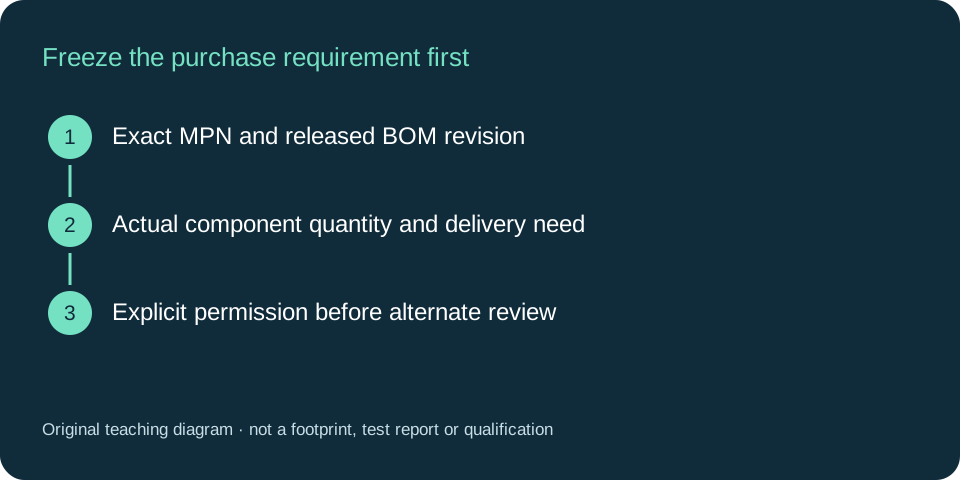
Copy EP4CE10E22I7N from the approved BOM and confirm that the source is the released revision. A maintenance spreadsheet, a purchasing history and a board marking can disagree because they were created at different stages of the product's life. Resolve that disagreement before requesting a different component. Otherwise, the team may spend time qualifying an alternative to a part that was never the correct requirement for the affected assembly.
Record the actual requested component quantity and the required delivery window. If the request supports repairs, distinguish the immediate usable quantity from a possible later purchase. If it supports a production run, identify the relevant board revision and assembly variant. These details do not establish supply, but they let a supplier describe a concrete offer and let the project owner judge whether a split delivery would help.
Next record one of two permissions: exact MPN only, or candidates may be proposed for engineering review. Do not let an empty permission field be interpreted as consent to substitute. A buyer can gather candidate information without authorizing a BOM change. A supplier can suggest a comparison without proving that it is suitable. The named design or quality owner must decide what evidence is needed before a candidate can become an approved purchase line.
The EP4CE10E22I7N evidence page preserves the reviewed package, grade and source conditions. Its current-ordering-page retrieval limitation is visible: the original row evidence is historical, while a later direct request to the manufacturer's ordering page was blocked. That gap must remain a gap. It does not imply that the device is active, discontinued, available or unavailable today.
The I7 and C9L core-voltage classes are different
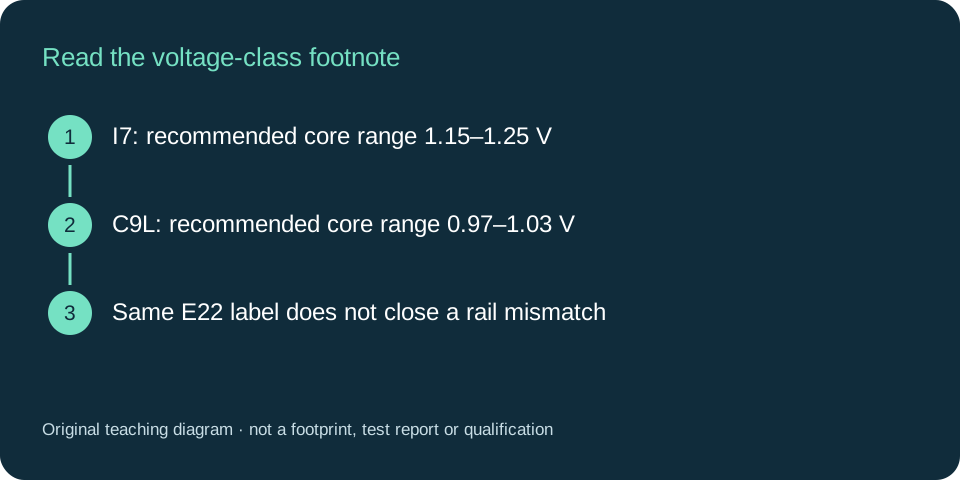
The Cyclone IV handbook's operating-conditions table and its notes identify the relevant speed classes. The standard 1.2 V core class includes I7; its recommended VCCINT range is 1.15–1.25 V. The 1.0 V class includes C9L; its recommended VCCINT range is 0.97–1.03 V. These figures are not absolute maximum ratings and are not a complete specification for every rail on the board.
That difference makes EP4CE10E22C9LN a useful counterexample to the idea that the same device and package name establishes a drop-in substitute. If a released design supplies the I7 core according to its documented class, a C9L offer cannot be accepted by comparing only the package text. The design owner must examine the actual power tree, rail tolerance, sequencing and relevant timing conditions.
Read the original Cyclone IV Device Handbook, the DC-characteristics section at PDF pages 450–451, printed pages 1-4 and 1-5. Table 1-3 and its first note are the reference used for this comparison. The source PDF was retrieved and these pages visually reviewed. Retain the document revision and table location with the record so the next reviewer can reproduce the interpretation.
A supplier statement such as “same package, lower power” does not answer whether your board supports the voltage class. Lower nominal voltage is not universally better; it is a design condition. Do not power an unqualified candidate from the existing board as a shortcut to evidence. Plan the electrical review and any later validation using the appropriate engineering controls, equipment and responsible personnel.
Equally, do not infer that a nominal-rail match completes the review. A rail may have transient behavior, tolerance or sequencing constraints that are absent from a short comparison table. The output at this stage should be a precise open question, such as “confirm candidate VCCINT operating class against the released regulator configuration,” rather than a broad “voltage compatible” checkbox.
Package I/O counts can move in the opposite direction to density
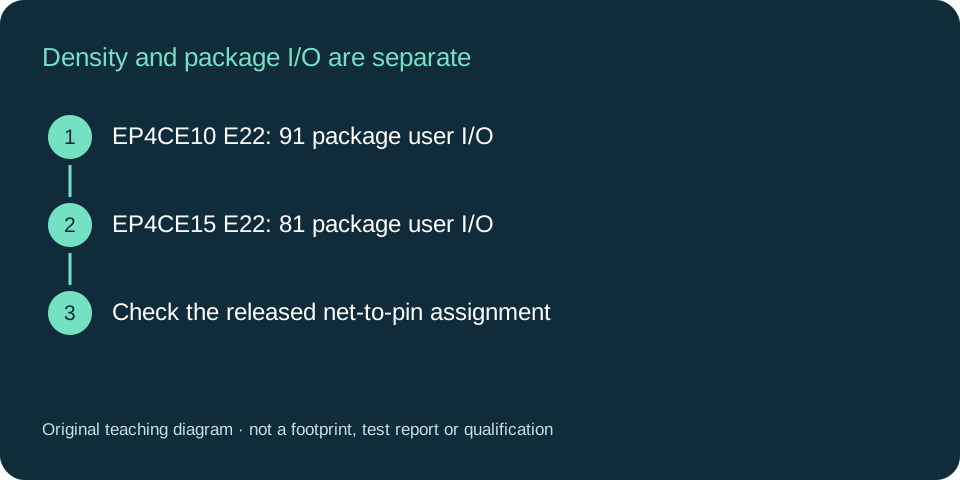
The reviewed EP4CE10 E22 implementation has 91 user I/O. The EP4CE15E22I7N implementation has 81. This is a practical reason to avoid sorting potential alternatives by a larger device number and assuming that the larger device must cover the smaller one. Internal resources and externally usable package connections are different dimensions of the design.
Even when two candidates have the same total user-I/O count, they may not provide the signals in the banks or positions required by the board. Compare the released pin constraints with the manufacturer package and pin information for each exact device. Record bank voltages, dedicated functions, clocks and configuration connections. A count is an early screening aid; it cannot establish the net-by-net mapping required for a board-level decision.
Keep package identity and assembly evidence distinct as well. The E22 label belongs to an ordering scheme; it is not a replacement for the applicable drawing, tolerances and land-pattern review. The original Cyclone IV ordering-information reference helps interpret ordering fields, but interpreting a code is not the same as proving that every generated suffix combination is a real orderable part. Use literal manufacturer evidence for the actual candidate.
For a fixed board, a known pin mismatch is a controlled change or redesign question. It is not an inconvenience that procurement can waive because the delivery date is urgent. If a board change is permitted, estimate that work separately: schematic review, layout impact, manufacturing files, implementation changes and validation. The shortage may still have a viable solution, but it is a different project from buying the exact original line.
Temperature, timing and configuration need their own owners
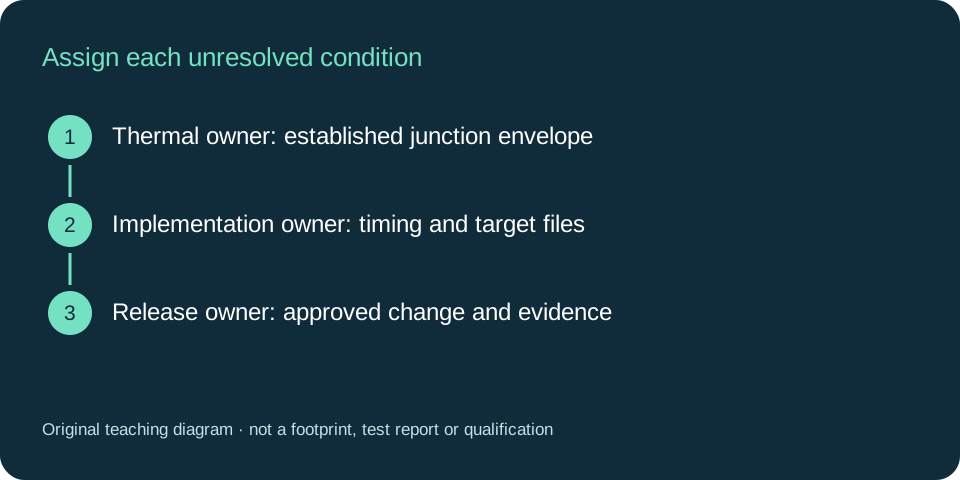
The I-grade operating junction interval in the cited table is −40 to +100 °C. The commercial interval is 0 to +85 °C. A C9L candidate therefore changes the temperature scope as well as the core-voltage class in this example. Do not substitute ambient temperature measurements for a junction-temperature requirement. The thermal owner must determine whether the relevant assembly conditions have been established and whether the product's qualification requirements permit the proposed grade.
Timing is another independent question. A speed-grade designation is meaningful within the manufacturer's characterized conditions, but it does not demonstrate that a particular design meets its constraints. Locate the released project, constraints, tool version and timing results. If those records are missing, the alternate review has an implementation-evidence gap. An attractive delivery date cannot close it, and an AI-generated explanation cannot replace the required engineering work.
Configuration and programming also deserve an explicit handoff. Identify which file is approved for the original assembly, how the target device is selected and what process verifies the programmed unit. A device-family resemblance does not prove that an existing programming artifact can be reused without change. Record who owns regeneration, review and acceptance of any new artifact before the procurement team treats the candidate as ready for a production order.
The FPGA PCB bring-up checklist provides a way to organize later power, clock, configuration and functional checkpoints. Use it as a planning aid after the candidate requirements are understood. Do not describe the presence of a checklist, an image or a proposed test as evidence that the candidate passed. A completed validation record must identify the actual hardware, revision, conditions, observations and responsible reviewer.
Turn missing evidence into a route, not a false pass
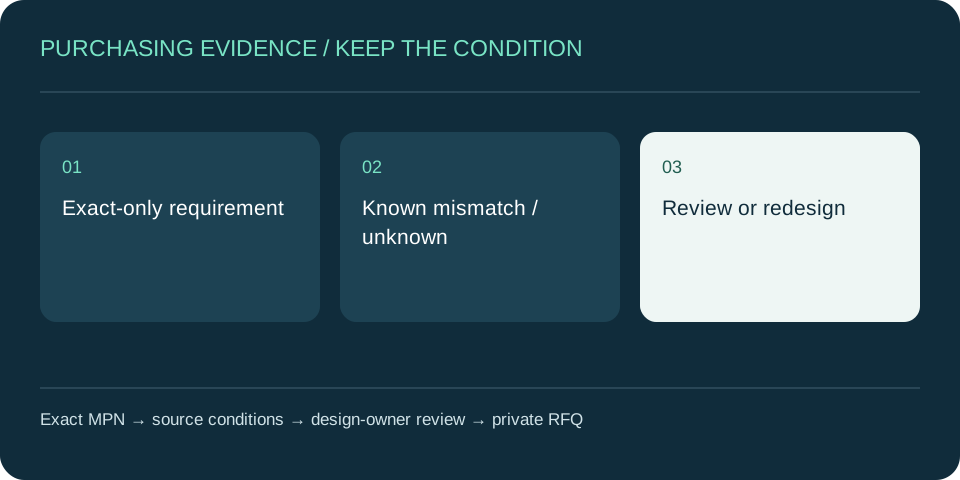
Use the route worksheet to record what you know about the proposed change. An exact-only requirement stays on the exact-sourcing route. If alternatives may be reviewed and a rail or pin difference is already known, the result points to the design owner. If those questions have not been checked, the result identifies missing evidence. Even two recorded matches leave timing, thermal, configuration, mechanical and supply evidence open.
Without JavaScript: keep exact-only requests unchanged; send known pin or rail differences to the design owner; leave unverified conditions open. No combination of these answers qualifies a substitute.
This intentionally modest output is more useful than a universal compatibility score. A score can conceal which condition is fatal and which is merely unconfirmed. A decision record should instead name the original MPN, candidate MPN, board revision, source versions and unresolved questions. Assign an owner and a required piece of evidence to each open item. That gives a real review meeting something concrete to resolve.
For example, a record may say that a supplier proposed the C9L part for an I7 requirement, that the voltage-class difference is documented, and that no engineering change has yet been approved. Purchasing can then request an exact-I7 offer in parallel while engineering decides whether a power-tree change is worth investigating. Neither path needs to pretend that the other has finished. Keep the records linked so a later quotation does not lose the original limitation.
The Hard-to-find sourcing workflow supports the same separation. A historical lifecycle notice belongs in the identity/lifecycle record, a proposed device change belongs in engineering review, and a current lot offer belongs in the supply record. The notice-reading guide is relevant if the shortage discussion introduces an EOL or replacement claim that still needs exact-row evidence.
Agree a stopping condition before the review expands. If the exact-only requirement cannot be changed and no acceptable offer exists, the appropriate outcome is an unresolved sourcing requirement. If a candidate has a known electrical mismatch and no redesign budget or owner, it should not remain on an apparently ready-to-buy shortlist. A clear disposition prevents repeated supplier conversations from gradually erasing the same unresolved constraint.
It is also useful to distinguish evidence that is missing from evidence that conflicts. A missing pin map calls for the correct document. Two contradictory records call for reconciliation: check revisions, package scope and the actual part identity before deciding which applies. The worksheet does not rank conflicting sources automatically. Preserve both observations and record why the final interpretation was chosen when the responsible reviewer resolves them.
A candidate can be commercially promising while technically unresolved. Keep that wording intact in meeting notes and purchasing systems. It lets the team preserve a useful contact without creating an accidental approval that a later buyer might trust.
Send an RFQ that preserves the decision you just made
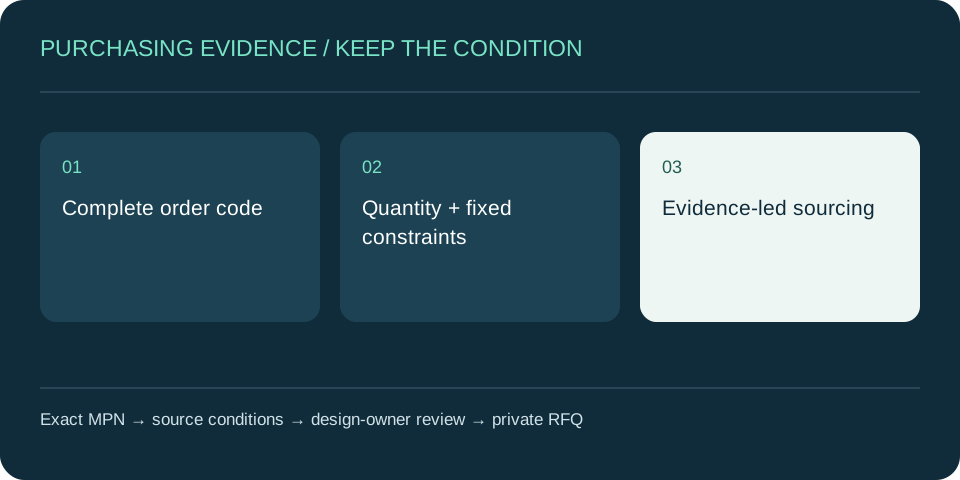
Prepare the request with the complete original MPN, actual component quantity, destination and required delivery window. State whether partial deliveries are useful and whether the exact manufacturer code is mandatory. If alternatives may be proposed, ask for the complete candidate code and the evidence supporting each claimed similarity or difference. Do not use the phrase “equivalent accepted” when the project actually requires a separate engineering decision.
Keep private project information in the form or agreed document channel rather than in a public link. The website's Contact route can preserve a part number and quantity, but it does not automatically transmit your downloaded evidence record or approve a substitution. Review the prefilled inputs, attach the relevant constraints privately, and submit only when the request describes what you intend to buy. No test enquiry is required to use the worksheet.
If no supportable exact-part offer or candidate emerges, define a redesign scope. That may involve the board, firmware, FPGA implementation, assembly process and acceptance tests. Use the board-build scope page to separate component supply from engineering and manufacturing responsibilities. A broader project can be a valid outcome, but it should have explicit deliverables and ownership rather than being hidden inside an alternate-part quotation.
Prepare an exact-MPN request for 25 units or prepare a separate 10-board project request. Quantities are editable examples. Confirm the actual requirement and alternative permission privately before submission.
AI-assisted original explanation and documentary review. No present shortage, approved substitute, human engineering sign-off or supplier stock is asserted.
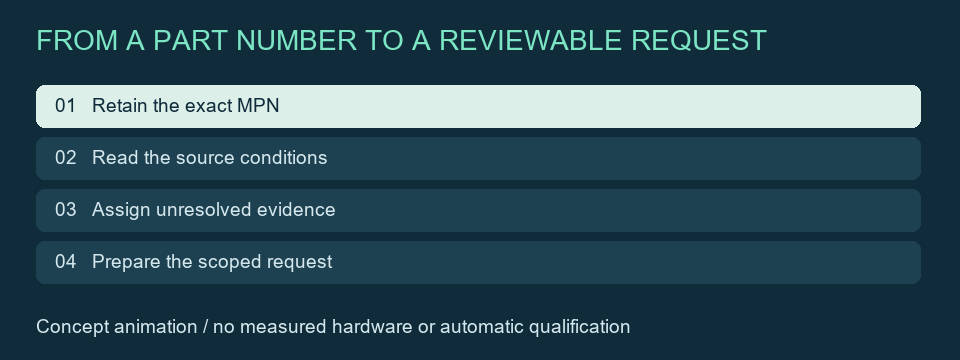
Open the animated steps; close to hide motion
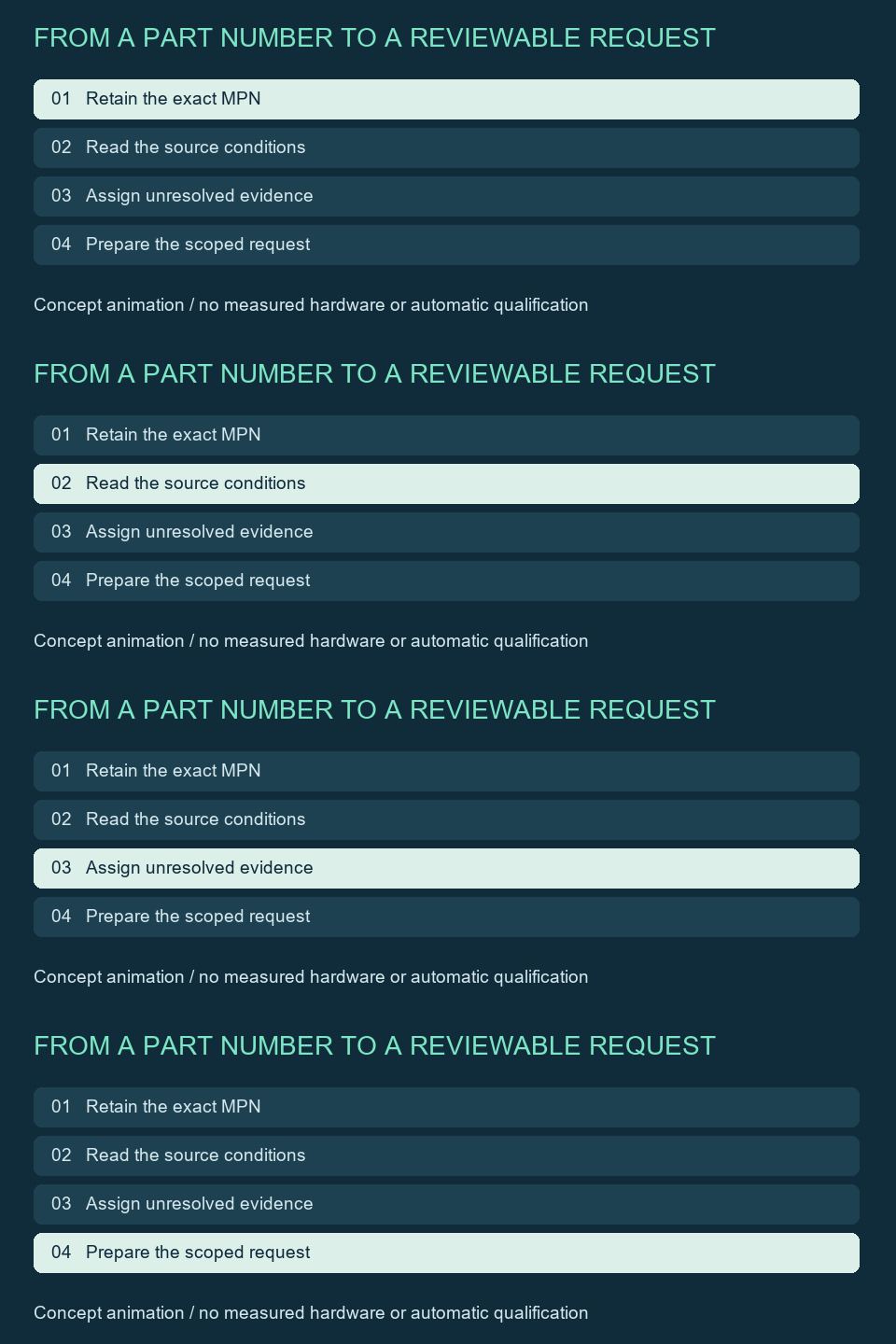
- Retain the exact manufacturer ordering code.
- Record the source revision and operating conditions.
- Assign unresolved evidence to its owner.
- Prepare an exact request or separately authorized change review.