
Industry Insights
The Cheaper FPGA May Cost More: Build a Substitute-Cost Worksheet
Published · Updated
First decide what you are comparing
A lower component price is only one term in a substitution decision. The replacement may require a board change, a new implementation run, additional validation or a different inventory commitment. Equally, a proposed change may need very little work if the exact design already has an approved alternate. The right starting point is therefore a defined comparison, not a universal rule that substitutes are either economical or dangerous. Identify the original approved design, the proposed MPN, the planned quantity and the work needed to make that option usable.
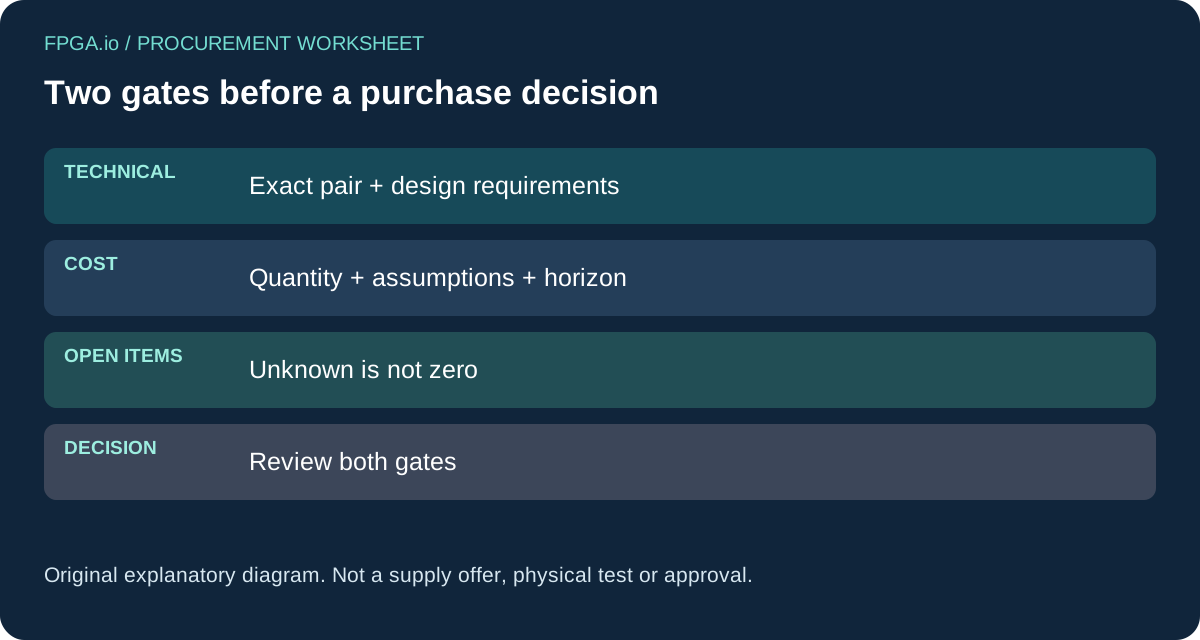
Separate two questions that are often combined in a purchasing spreadsheet. Is the proposed device technically acceptable for this design? If it can be accepted, what costs belong to choosing it for the stated production quantity? A favorable cost result cannot answer the first question. A negative result does not prove technical incompatibility. Keep the compatibility decision in its own record and use this worksheet only to organize a cost scenario. No market prices, vendor quotations or expected savings are supplied by the tool.
Define the comparison baseline carefully. It might be continued procurement of the approved component, an already qualified alternate, or a redesign that would happen regardless of the shortage. If the original part cannot actually be purchased, mark its price as a reference assumption rather than an available option. Comparing a deliverable alternate against a fictional baseline can still help explore a scenario, but it cannot establish an executable purchasing choice. A stale quotation needs its date, quantity and validity limitations preserved.
Choose a decision horizon as well as a quantity. A one-time service repair and a repeat production program can distribute engineering effort very differently. Do not silently charge a full development program to a small service lot, or spread it across future units that have no approved forecast. State what volume the calculation covers and what would make you revisit it. This makes the result useful to purchasing, engineering and project management even when several inputs remain unknown. The immediate output is a transparent assumption set, not a recommendation to buy.
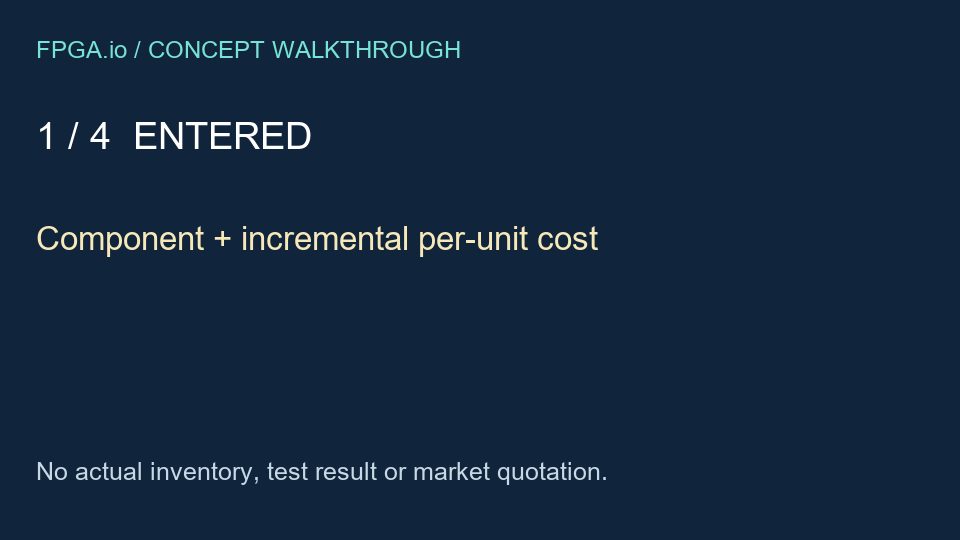
Play the conceptual walkthrough (close to hide motion)
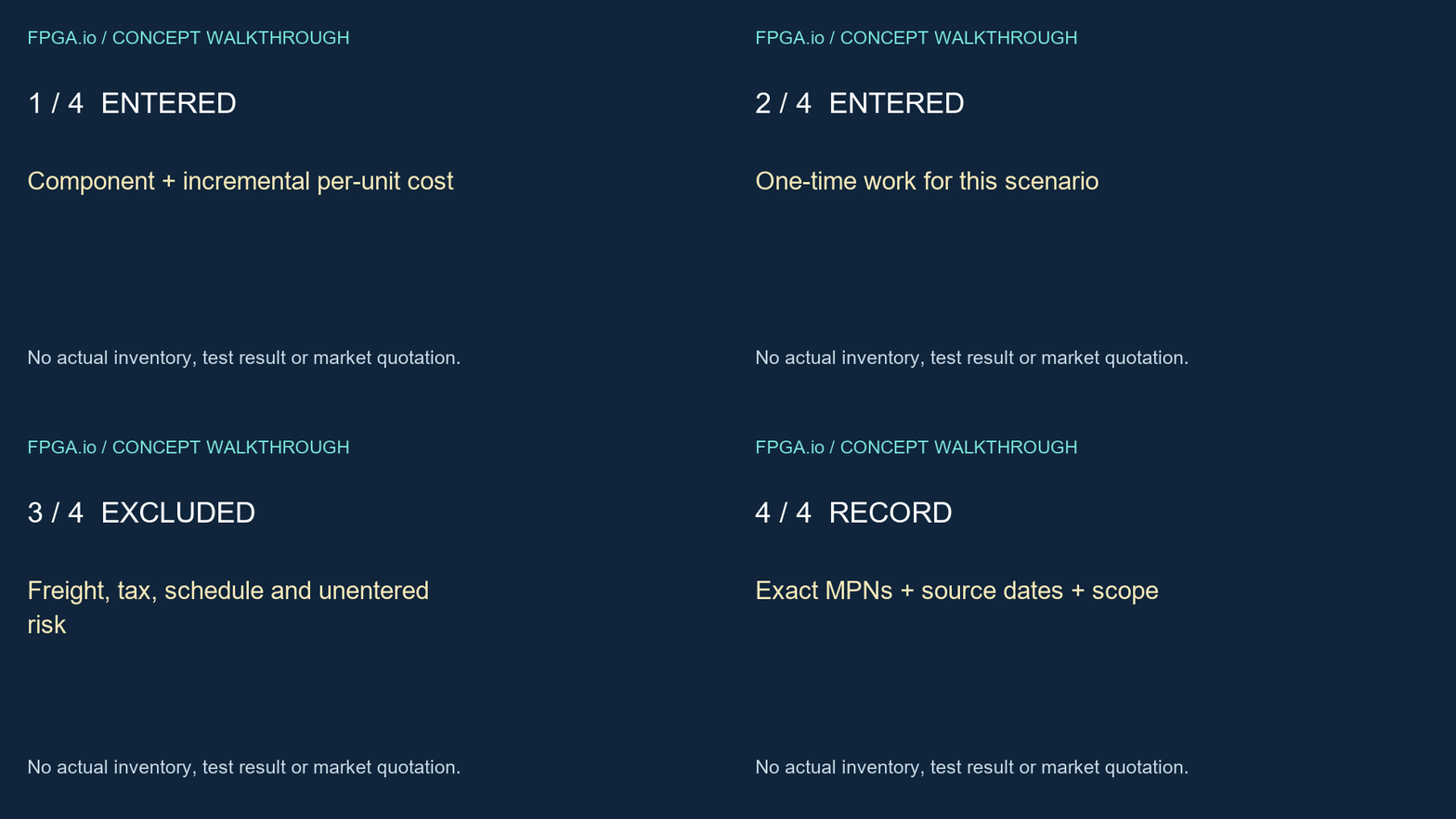
Reduced motion: use the static poster and transcript.
Read the walkthrough transcript
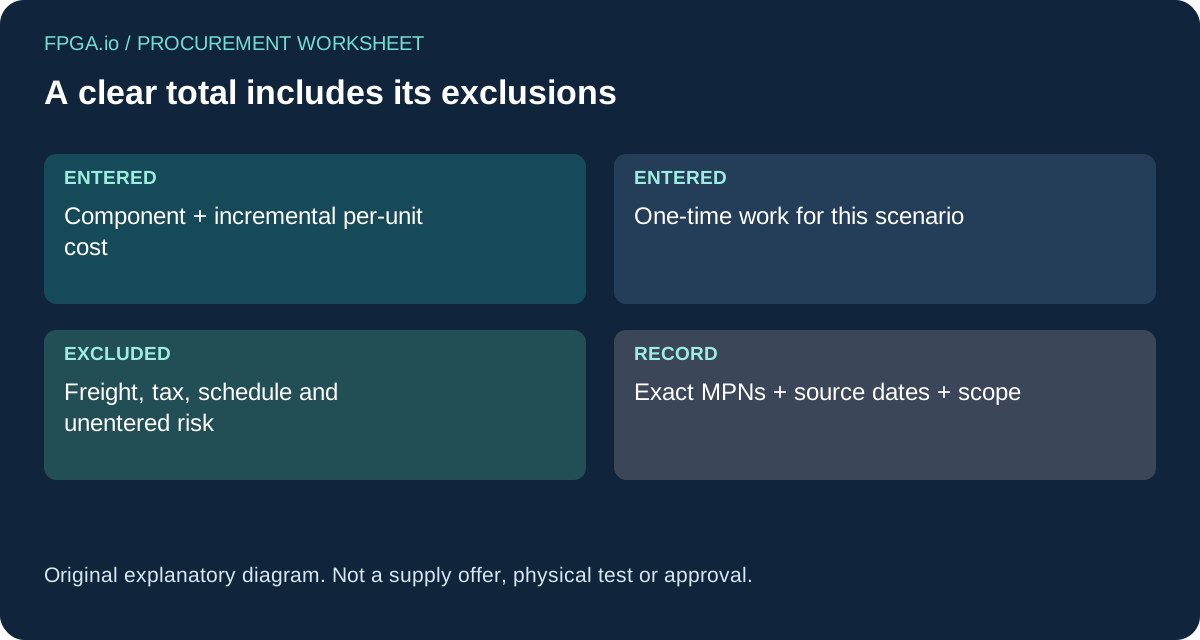
- ENTERED: Component + incremental per-unit cost
- ENTERED: One-time work for this scenario
- EXCLUDED: Freight, tax, schedule and unentered risk
- RECORD: Exact MPNs + source dates + scope
A matching footprint does not make engineering work disappear
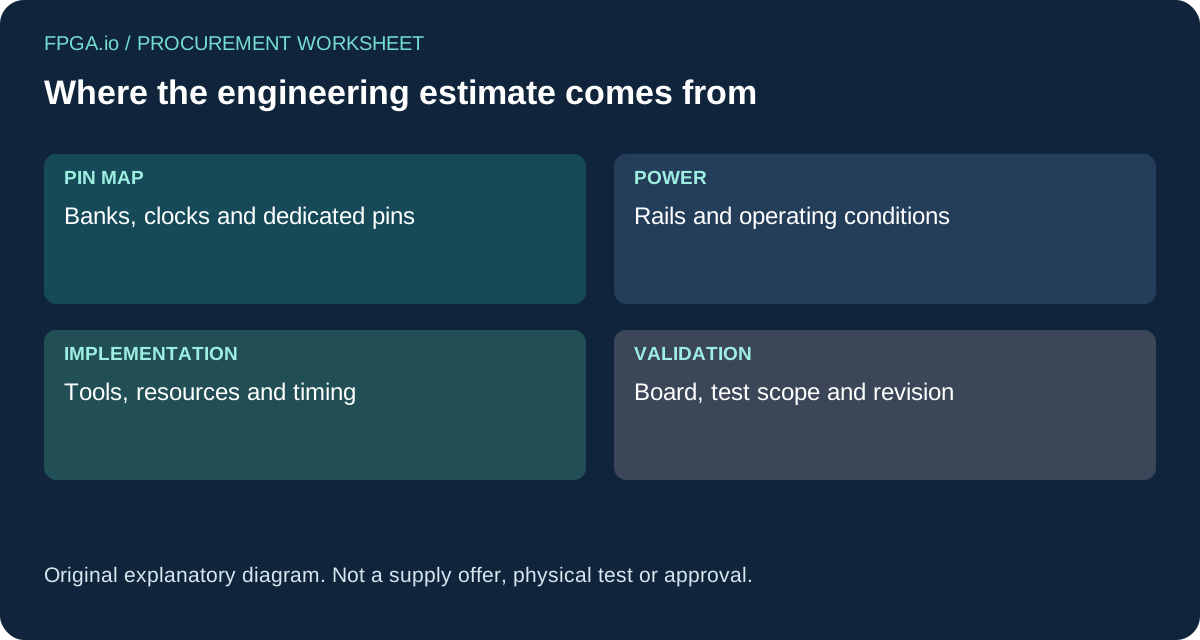
Begin the engineering estimate with the actual migration questions. The AMD 7 Series packaging and pinout guide discusses device migration within its defined families and packages, including differences in banks, pin functions and decoupling requirements. Those conditions are a reason to review the exact pair and board; they are not a universal promise that equal ball counts work. The cost model should point to the technical review rather than treating package similarity as a zero-cost approval.
List the tasks that could change in your project: exact pin-map comparison, bank and rail checks, resource mapping, timing closure, clocking, configuration, programming, and the relevant software or IP environment. For each, identify whether the work is already completed, planned, not applicable with a reason, or still unestimated. A completed review can reduce the remaining effort, but only within its documented scope. A tool opening the project successfully does not establish that the design has met timing or passed a hardware validation plan.
Keep rates and hours separate when making an estimate outside the calculator. Then bring the resulting one-time amount into the worksheet with a reference to that estimate. This avoids hiding an unsupported number under a vague engineering allowance. If the same engineer must perform two tasks sequentially, the schedule implication is separate from the cost sum. If a license, fixture or external service is already covered by an existing project, decide explicitly whether the comparison includes an incremental charge or only the additional work.
For a concrete technical context, compare the questions raised by a temperature-grade change with those raised by a different package or voltage option. The first may require confirmation of the product's actual operating conditions and approved grade. The second can add rail, layout or pin-map work. Neither scenario has a fixed universal price. The linked Artix-7 grade comparison and Cyclone IV alternate checklist show the evidence questions; they do not provide a cost estimate for your board. Use them to define the work before asking someone to price it.
Separate one-time costs, per-unit costs and quantities
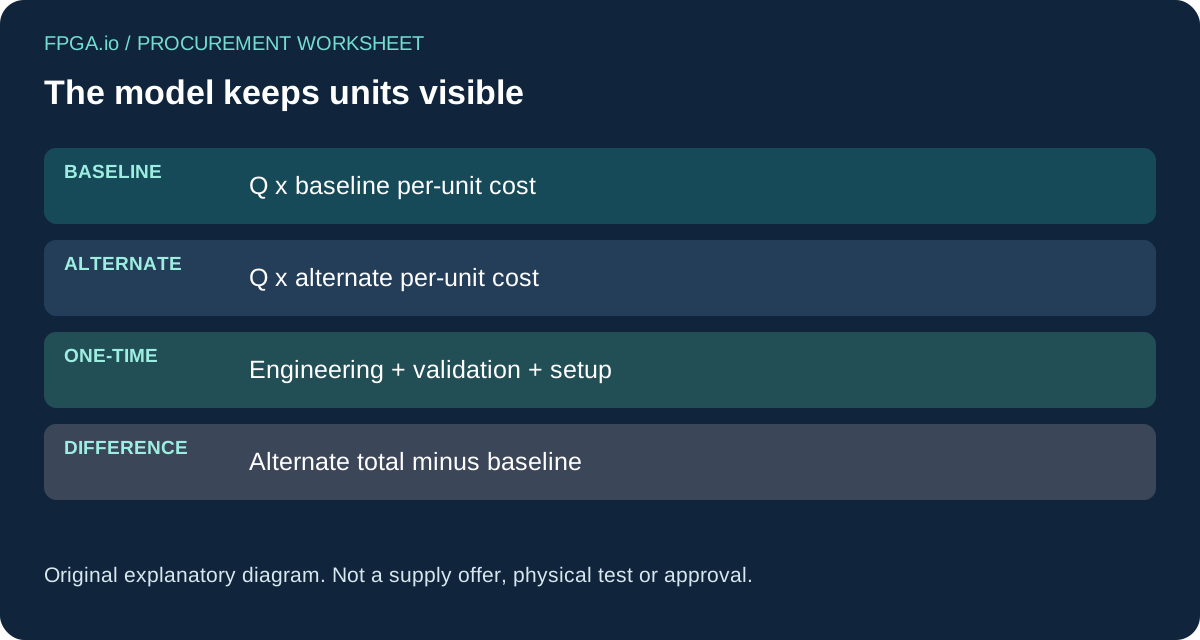
The worksheet uses a deliberately small model: one-time cost plus planned quantity multiplied by the included per-unit cost. Enter the baseline and alternate component prices separately. Add other incremental per-unit amounts only when you can explain what they represent, such as a changed board or assembly process. Enter one-time engineering, validation and other setup amounts on their own lines. All monetary entries must use the same three-letter currency code. The tool does not perform currency conversion or infer an exchange rate.
For this model, the baseline is quantity multiplied by its included per-unit amount. The alternate is quantity multiplied by its included per-unit amount, plus its entered one-time costs. The difference is alternate total minus baseline total. A positive difference means the included alternate scenario costs more; a negative difference means it costs less under those inputs. That sign convention is printed with the output. It does not represent profit, a supplier discount or a prediction of the amount you will actually spend.
Quantity requires particular care. The number of boards in a build is not always the number of FPGA packages required. If there are two devices per board, or separate prototypes and production units, calculate the relevant component quantity first and document it. Minimum order quantities, reel purchases, spare units and yield assumptions can change the purchased quantity. They are excluded unless you deliberately include their effect in the entered scenario. Do not double-count a whole extra reel as both a component unit-price adjustment and an additional fixed cost.
A blank cost is unknown, not zero. The worksheet therefore requires an explicit nonnegative entry for each cost field before calculating. If an item has no incremental cost within your defined scope, enter zero and retain the reason in the assumptions note. If the amount is not known, leave it blank and treat the incomplete calculation as a reminder to request it. This small distinction is more useful than a polished total that silently assumes free engineering, free testing or no inventory impact. Negative costs are rejected; credits need a separately documented treatment outside this simple model.
Read a break-even quantity as a conditional threshold
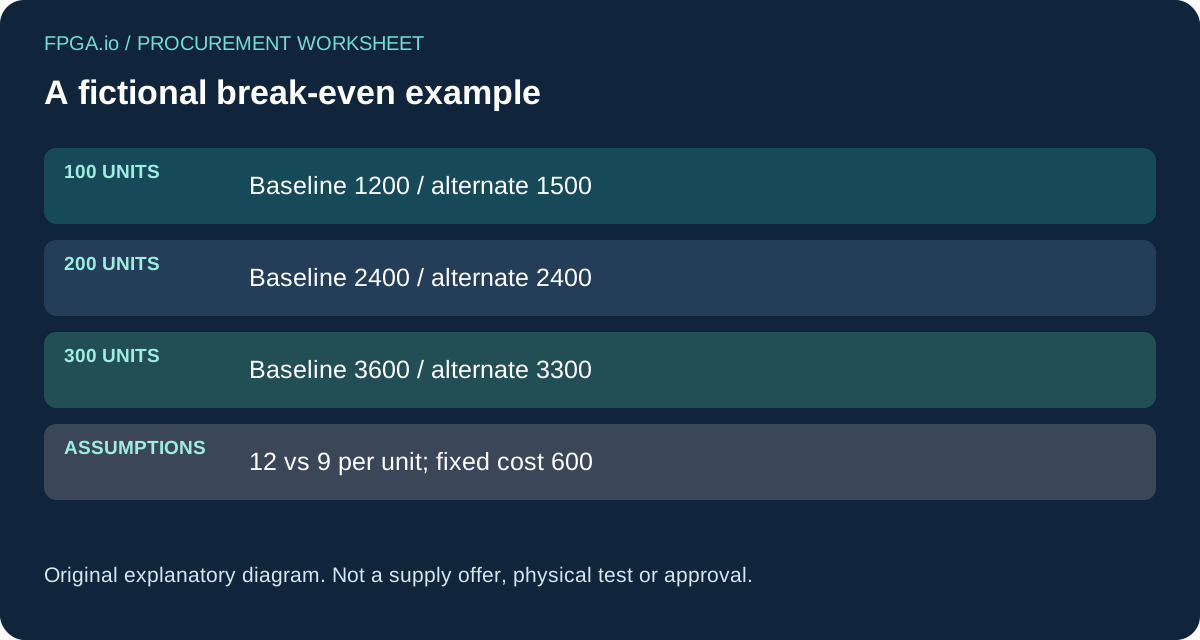
A break-even quantity is useful only when the alternate has a lower included per-unit cost. Divide the entered one-time cost by the per-unit difference between baseline and alternate, then round upward to a whole component. The result is the smallest whole quantity at which the modeled alternate total is no greater than the baseline total, assuming those same prices and costs apply. It is not a forecast of demand, a promise of savings or a recommendation to build inventory merely to cross the threshold.
Use a deliberately fictional example to inspect the arithmetic. Suppose the baseline costs twelve currency units per component, the alternate costs nine, and the alternate requires six hundred currency units of one-time work. With all other included costs explicitly zero, the per-unit difference is three and the break-even quantity is two hundred components. At one hundred components, the baseline is twelve hundred and the alternate is fifteen hundred. At three hundred components, the baseline is thirty-six hundred and the alternate is thirty-three hundred. These numbers are teaching inputs, not FPGA prices or supplier quotations.
If the alternate has the same or a higher per-unit cost, there is no positive-volume break-even created by spreading a nonnegative setup cost. The tool reports that condition instead of dividing by zero or returning a negative quantity. If setup cost is zero and the alternate has a lower per-unit cost, the alternate is lower from the first positive component quantity under the entered assumptions. This wording keeps a mathematical zero threshold from suggesting that an order for zero devices is a meaningful purchasing choice.
Now test the sensitivity of the fictional example. Doubling the setup estimate doubles the threshold when the per-unit difference stays fixed. Reducing the per-unit difference also raises the threshold. That is why an uncertain engineering estimate or a quantity-dependent supplier price deserves more attention than an extra decimal place in the output. Calculate separate scenarios for the plausible assumptions and retain their labels. Do not average incompatible quotations, currencies or purchase quantities into one result and describe that average as a confirmed commercial option.
Use the calculator to expose what the total leaves out
Enter the exact baseline and alternate MPNs, the component quantity and a currency code before entering costs. Those identity fields are retained in the exported text so that a total cannot easily become detached from the proposed devices. Add an assumptions note that identifies the estimate or quotation dates and the decision horizon. The tool performs arithmetic locally in the browser; it does not contact suppliers, check availability, perform a compatibility review or send your values to the website.
The output lists the entered per-unit amounts, the one-time subtotal, both totals and the difference. It also prints the exclusions: taxes, freight, duties, financing, unentered inventory commitments, schedule impact and failure risk are not modeled. If those matter to your decision, assess them separately and state how they affect the comparison. A line-down scenario in particular can be dominated by time rather than component price. Do not assign a convenient monetary value to a delay without a project owner and a defensible basis.
Use the assumptions text to explain explicit zeros. For example, validation may already be completed under a named design revision, or an existing fixture may support both configurations without additional work. Those are scoped statements requiring a record; they are not general facts about the part numbers. When an input changes, the previous output is cleared and its export is disabled until recalculation. This prevents a saved number from appearing current after the quantity or price has been edited.
The static fallback is intentionally simple: write both exact MPNs, the horizon and quantity; list baseline and alternate per-unit amounts; total the alternate's one-time work; calculate both scenario totals; compare them; and list all exclusions and unanswered technical questions. A spreadsheet can reproduce the same method. The value is in the assumptions and scope, not the calculator interface. Before sharing an exported record, remove confidential supplier names or pricing if the recipient is not authorized to see them. Public links should carry the MPN and quantity, not private commercial terms.
Calculate a scoped cost scenario
Local processing only. Nothing is submitted automatically.
Enable JavaScript for the worksheet, or use the static method below.
Static worksheet and method
Baseline = Q x baseline per-unit amount. Alternate = Q x alternate per-unit amount + one-time costs. Difference = alternate minus baseline. Break-even exists only when alternate per-unit amount is lower; round setup / per-unit difference upward. Blank inputs are unknown.
Make the next request a decision-ready quotation
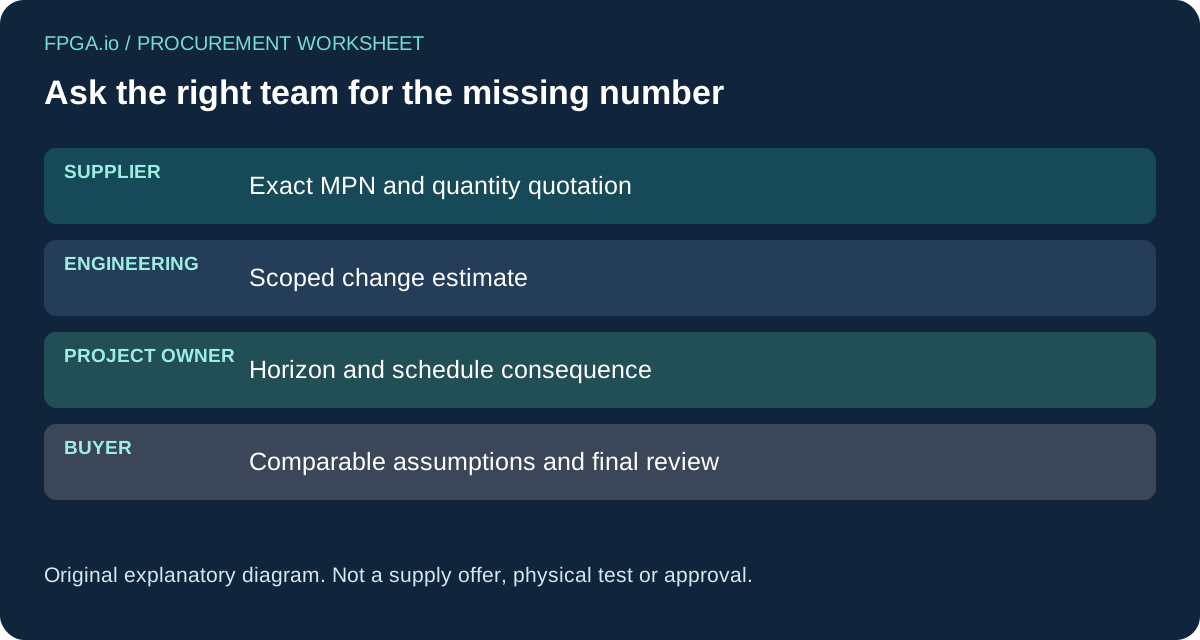
Once the technical work and cost assumptions are visible, ask for the missing information in separate requests. A component RFQ should identify the complete MPN, required quantity, delivery destination at the appropriate private stage, packaging conditions and any traceability requirements. A project inquiry should identify the board revision, proposed substitution, fixed interfaces and the engineering or manufacturing work to be reviewed. Combining those into a vague request for the best replacement invites responses that cannot be compared consistently.
Keep the supplier's unit-price response separate from your internal engineering estimate. They answer different questions and may have different validity periods. Ask whether a price applies to the exact quantity and lot arrangement under discussion, and record any minimum-purchase condition rather than hiding it in the nominal unit price. If the offer changes to another MPN, create a new scenario. A cost worksheet should not preserve an attractive total while silently changing the package, grade or quantity that produced it.
Before selecting an option, review both gates: the evidence supporting technical acceptance and the completeness of the commercial scenario. The person approving the engineering change may not be the person approving a purchase commitment. Record the decisions through your own controlled process. A saved calculation is an input to that process, not an authorization. This distinction is especially important when a shortage creates pressure to move quickly; the worksheet is designed to make assumptions easier to inspect, not to bypass the people responsible for them.
Use the related BOM guide to prepare consistent line quantities and the exact-order tutorial to preserve the requested and offered strings. Continue to a product page only for the stated device's evidence and conditions, not as proof that a substitute is interchangeable. If the work expands into a board change, use the project CTA and describe the scope privately. FPGA.io can receive component or project requirements for evaluation, while stock, price, schedule and feasibility remain to be confirmed. A worthwhile result is a comparison another engineer or buyer can reproduce, challenge and update when the evidence changes.
Source scope and editorial method
- AMD UG475: 7 Series packaging and pinout — Version 1.20, March 13, 2024, p.27: pin compatibility and migration conditions. Retained original PDF archive retrieved 2026-11-01; current web text reviewed 2026-11-03. No new mechanical or pin-map approval.
- AMD: Board and system design files — Official file-directory scope read 2026-11-03. Availability of pinout/BSDL files is not validation of a proposed pair.
AI-assisted editorial preparation and second source/calculation review. Original workflow and hypothetical examples; no human engineering certification, laboratory result or customer case is claimed. Manufacturer sources support their stated technical scope, not the original cost model or a commercial offer.