
Industry Insights
Same Pin Count, Wrong FPGA: How to Stop a Bad Cross-Reference
Published · Updated
Freeze the board constraints before comparing candidates

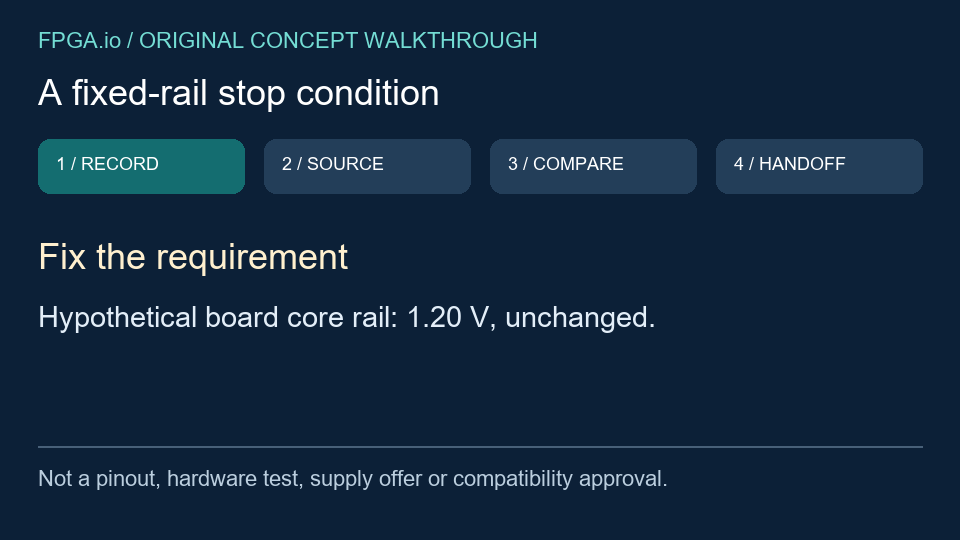
Play the concept walkthrough (close to stop viewing motion)

With reduced motion enabled, use the poster and transcript below.
Read the walkthrough transcript
- Fix the requirement: Hypothetical board core rail: 1.20 V, unchanged.
- Read the stated range: Cyclone IV E C8L core: 0.97 to 1.03 V.
- Record the conflict: The assumed rail is outside this recommended range.
- Keep other gates open: Pin map, timing and project approval remain unassessed.
A suggested FPGA replacement often arrives as a short list with a familiar package size, a similar resource count and a lower price. Those features may justify investigation, but they do not identify the conditions under which the existing board will work. Start by writing down what must remain unchanged. If the PCB cannot change, say so. If the power rails, programming process, firmware image or approved temperature range are fixed, record each constraint separately. A cross-reference becomes useful only when it is evaluated against those actual requirements.
This article uses an explicitly hypothetical purchasing exercise: a board has a fixed 1.20 V core supply and purchasing receives a lower-voltage Cyclone IV E suggestion in the same F17 package category. There is no customer board, laboratory result or verified supplier offer behind the exercise. The manufacturer’s operating limits allow us to identify a voltage conflict under the stated assumption. They do not allow us to claim that the complete devices have otherwise been qualified against one another.
Keep requested and proposed manufacturer codes in different fields. For the exercise, compare EP4CE22F17C8N with EP4CE22F17C8L as documented existing catalogue examples. Their exact-order records and the applicable family documents must accompany a real review. The present Altera ordering portal access gap remains separate from the archived identity evidence: an older record is not a present-day availability confirmation. This is a technical constraint exercise, not a recommendation to purchase either device.
Define what would count as a useful outcome before opening a comparison table. One outcome is a documented reason to reject the candidate for an unchanged board. Another is a list of missing evidence that prevents a decision. A third is an engineering-change proposal with a defined scope. A list in which every row looks similar is not a fourth outcome called automatically approved. Someone still needs to evaluate the implementation and authorize the change through the project’s real process.
A small set of fixed constraints helps purchasing avoid an unproductive search. It also allows engineering to focus on the first meaningful conflict rather than spending hours comparing features that cannot rescue a candidate already excluded by a non-negotiable requirement.
Reject the rail conflict without pretending to finish qualification

The Cyclone IV data sheet, CYIV-53001-2.1, Table 1-3, gives different recommended core-voltage ranges for its 1.2 V and 1.0 V groups. Note 1 associates the C8 grade with the 1.2 V group and C8L with the 1.0 V group. The listed ranges are 1.15 to 1.25 V and 0.97 to 1.03 V respectively. Under our fictional fixed 1.20 V assumption, the proposed low-voltage group is outside its recommended core operating range.
That is enough to stop an unchanged-board substitution review at this gate. It is not necessary to establish every other property before recognizing this particular conflict. However, describe the finding accurately: the proposed part does not meet the fixed core-rail condition in the exercise. Do not embellish it into a claim about observed damage, a measured failure rate or all possible redesigned applications. No physical board was powered and no manufacturer qualification was performed for this article.
Changing the regulator setpoint would change the question. The review would then need to establish what else uses that rail, which digital PLL supply conditions apply, the power-up requirements, available current and transient behavior, and the design’s timing assumptions. A new nominal voltage does not by itself complete that investigation. Treat the work as a potential board or power-system change with its own owner, test plan and cost. Purchasing should not silently authorize it by accepting a different ordering suffix.
Include tolerances whenever evaluating a real supply. A nominal number is only one point in its operating envelope. Regulator accuracy, line and load behavior, transient excursions, voltage drop and measurement location affect the voltage actually seen by the device. For this exercise the nominal 1.20 V already conflicts with the low-voltage group, so those additional details are not needed to identify the first stop condition. They remain necessary when evaluating a candidate that survives the initial screen.
Use recommended operating conditions for this decision, not absolute maximum ratings. A stress limit does not promise correct operation at that limit. Mixing the two tables can make an unsuitable candidate appear acceptable and gives a false sense of certainty precisely where the purchase record should be asking for additional engineering evidence.
A matching package count leaves the electrical map unresolved

The Cyclone IV E ordering diagram identifies F17 as a 256-pin FBGA package category. That fact helps locate relevant package documentation, but it does not prove that every device described with 256 pins will fit the same board. A pin count says how many connections are present. It does not say which position carries a particular power supply, bank signal, reference, clock or configuration function. Electrical mapping must be reviewed against the exact device and package.
Separate the evidence into mechanical and electrical records. The mechanical record covers body dimensions, pitch, height and the drawing or footprint assumptions needed for assembly. The electrical record identifies the position-by-position functions used by the schematic and design constraints. For an unchanged PCB, check both against the controlled board revision. If a drawing is available but an exact pin map is missing, mark the electrical row unknown. Do not copy the mechanical result into that field to make the checklist look complete.
Bank requirements deserve more detail than a total user-I/O count. A board may need a particular voltage on a particular bank, a differential pair at specific locations, or a clock-capable connection associated with a defined clocking resource. A larger device can still fail one of these constraints. Conversely, unused connections do not automatically make every difference harmless: power, configuration and reserved-pin rules can apply even when the application does not use the surrounding logic.
Where a manufacturer publishes migration guidance, read the conditions around it. The guidance may identify a subset of device/package combinations or require pin planning that the existing board did not follow. Record the relevant table and notes, then compare them with the actual schematic and constraint files. A distributor’s phrase such as compatible package does not extend the manufacturer’s stated migration conditions. Ask what exactly is meant and what source supports the claim.
This article has not completed a ball-by-ball comparison for the example pair. The matrix therefore keeps mechanical detail and pin mapping unresolved. That is a useful result: the core conflict is known, while other properties remain unassessed. A professional review can reject a candidate at one gate without inventing completed work for every remaining gate.
Configuration and timing can fail after the board appears to fit

Physical fit is only one layer of an FPGA replacement. The project also needs a supported configuration flow and an implementation that meets its constraints. Record the design tool version, selected device, relevant IP versions, programming method and the identity of the released image. If the candidate requires a different build, make that change visible. A device programming successfully does not prove that the application meets timing, resets correctly or behaves as intended at the system interfaces.
Treat the released bitstream as belonging to a specific controlled build, not as a generic family file. The responsible engineer must establish what the proposed device accepts and what must be regenerated or revalidated. Avoid copying an image onto a different device as a shortcut to compatibility approval. Configuration settings, initialization behavior and design-specific assumptions can matter even when the source RTL appears portable. Document required checks rather than claiming that an untested migration will work.
Timing review also needs the actual implementation. Speed grades are bins defined by manufacturer data, not a universal system-frequency guarantee. A source that says one grade is faster does not demonstrate that a particular placed-and-routed design meets every internal and external timing requirement on an alternate. Record the relevant timing constraints, reports, clock relationships and exceptions, together with the voltage and temperature conditions assumed by the analysis.
Temperature limits add another boundary. The data sheet generally identifies junction-temperature operating conditions, while the application may specify ambient or enclosure conditions. Converting one to the other requires an appropriate thermal assessment. A higher maximum junction rating does not automatically resolve a cold-start requirement, and a favorable room-temperature test does not cover the whole operating range. Keep the required environment and the evidence used to support it in separate fields.
Decide which validation belongs to design review, which to a representative prototype and which to production control. These activities answer different questions. Simulation, implementation reports, functional checks and manufacturing tests can contribute evidence, but none should be represented as performed until a real record exists. The comparison worksheet is a way to organize the missing work, not a substitute for those records or the project’s approval authority.
Make unknown visible in the comparison matrix

The matrix below offers four evidence states: same, different, unknown and not assessed. They describe the review record, not an automatic verdict on the proposed device. Same means the reviewer has evidence of agreement for that specific row. Different means an identified difference remains to be interpreted against the stated project constraint. Unknown means the question has been investigated but the needed fact is missing. Not assessed means that review work has not yet been done.
A separate fixed-constraint choice distinguishes a relevant conflict from a change that might be permitted. If a reviewed row differs and the requirement is fixed, the tool reports an unresolved fixed-constraint conflict. It does not calculate a compatibility percentage or let several matching rows outweigh a power or pin-map problem. If the constraint is not fixed, the same difference becomes a change to evaluate. Unknown or unassessed rows remain visible regardless of the number of matches elsewhere.
Enter a source or review reference beside every same or different result. For the fictional rail example, cite the Cyclone IV data sheet revision, Table 1-3 and note 1, together with the assumed fixed 1.20 V board rail. For a real board, use its actual controlled schematic and supply specification instead. The tool treats a claimed comparison without a reference as missing evidence. This prevents a clicked selector from looking like a completed technical review.
Try three deliberate states. First, mark all rows not assessed; the output should ask for review work. Next, set the core-rail row to different, mark it fixed and provide the reference; the output should expose the conflict. Finally, imagine all rows marked same with references. The output must still state that this is a recorded comparison and requires authorized engineering disposition. A completed form is not an independent validation result.
The text export preserves the requested code, candidate code, each row’s state, its constraint setting and source note. Keep this report in the private project record; it contains whatever the reviewer entered. No report is transmitted automatically. A static checklist remains available if scripting is unavailable, and the Contact links work without the interactive matrix. Avoid pasting confidential netlists, personal details or supplier terms into public URLs.
Make a review record
Processed in this page only. No automatic submission or approval.
Enable JavaScript for the worksheet, or use the static checklist below.
Static checklist and no-script fallback
Record requested and offered MPNs separately; add manufacturer, quantity, source revision and page. For each engineering condition, retain the evidence state, fixed/change permission and unresolved action. Matching fields do not establish compatibility. Use the Contact links below after resolving the identity.
Give purchasing a decision they can act on

A useful sourcing handoff names the candidate and the next action. For the fixed-rail exercise, the action is to stop treating the low-voltage suggestion as an unchanged-board replacement. Purchasing can continue searching for the exact approved code, or ask whether an engineering-change study is authorized. Those are separate routes. Neither requires claiming that every other feature of the candidate has been assessed, and neither promises that an alternate will ultimately be accepted.
When evidence is missing rather than conflicting, describe the missing item precisely. Ask for the complete manufacturer ordering number, the applicable package drawing, a manufacturer migration statement with its conditions, or a controlled implementation review as appropriate. A vague request to confirm compatibility tends to produce an equally vague answer. A specific missing-evidence request is easier to assign, verify and close without confusing commercial confidence with engineering proof.
Use the published EP4CE10E22I7N alternate-review article for another example of keeping identity, core voltage and package questions separate. Use the PCB bring-up checklist when the inquiry develops into an actual board change. The Hard-to-find route is appropriate for exact-part sourcing and lifecycle questions, but a historical replacement recommendation still needs its original conditions. An affected part and a listed replacement do not automatically share the same discontinuation event.
For an exact component inquiry, supply the approved full MPN and required quantity, then state whether substitutions are prohibited or merely subject to review. Ask for traceability and delivery information as information to be confirmed. For a project inquiry, identify the controlled board revision, fixed interfaces, permitted changes and required review output. Do not put the full private matrix into a query string; use the private submission process for detailed project information.
The final record should distinguish rejected for a stated constraint, awaiting specified evidence and referred for authorized engineering review. Preserve the source versions and assumptions that led to that status. This gives the next buyer or engineer a reproducible starting point. The value of a cross-reference is not how quickly it produces a replacement name. It is whether the evidence helps the team avoid an unsuitable purchase and choose a defensible next action.
Manufacturer evidence and boundaries
Document retrieval dates below are retained from the evidence archive. Reading a cached document does not certify current stock or refresh manufacturer lifecycle status.
- Cyclone IV FPGA Device Family Overview - standalone chapter — CYIV-51001-2.0; p. 12 / printed p. 1-12, Figure 1-3, package and grade decoding. Ordinary industrial range is separate from conditional extended-temperature operation.. Retrieved 2026-11-01T15:33:09.109Z.
- Cyclone IV Device Handbook, Volume 3, Chapter 1: Cyclone IV Device Datasheet — CYIV-53001-2.1; PDF pp. 450-451; printed pp. 1-4 through 1-5; Table 1-3 Recommended Operating Conditions for Cyclone IV E Devices, both parts and notes.. Retrieved 2026-11-01T15:33:13.548Z.
- 7 Series FPGAs Packaging and Pinout Product Specification — 1.20; pp. 10-18 package/transceiver/I/O tables; pp. 255-291 mechanical drawings. Retrieved 2026-11-01T15:32:57.280Z.
- Artix 7 FPGAs Data Sheet: DC and AC Switching Characteristics — 1.27.1; p. 3, Table 2, Temperature; p. 1 introduction. Retrieved 2026-11-01T15:32:58.965Z.
AI-assisted editorial draft. No hardware test, human engineering certification or customer case is claimed.