
BASE DEVICE
XC2S50
Spartan-II base device for legacy design maintenance. Package, speed and temperature suffixes are required to identify an orderable part.
- Logic cells
- 1728 cells
- Configurable logic blocks
- 384 CLBs
- Block RAM
- 32 Kbit (1024 bits)
AMD / Xilinx / Chips & IP
Historical selection guide covering Spartan-II/IIE and Spartan-3 branches; use family data sheets and discontinuation notices for exact parts.
Product lines are representative. Stock, lifecycle, package and grade must be checked against the exact MPN.
FROM FAMILY TO DEVICE
Base-device names are distinct from full ordering numbers. Each detail page identifies the product type, parameter scope and official source.
BASE DEVICE
Spartan-II base device for legacy design maintenance. Package, speed and temperature suffixes are required to identify an orderable part.
BASE DEVICE
Spartan-IIE base device for legacy design maintenance. Package, speed and temperature suffixes are required to identify an orderable part.
BASE DEVICE
Spartan-3 base device for legacy design maintenance. Package, speed and temperature suffixes are required to identify an orderable part.
BASE DEVICE
Spartan-3A base device for legacy design maintenance. Package, speed and temperature suffixes are required to identify an orderable part.
BASE DEVICE
Spartan-3AN base device for legacy design maintenance, with integrated configuration flash. Package, speed and temperature suffixes are required to identify an orderable part.
BASE DEVICE
Spartan-3E base device for legacy design maintenance. Package, speed and temperature suffixes are required to identify an orderable part.
BASE DEVICE
Spartan-3E base device for legacy design maintenance. Package, speed and temperature suffixes are required to identify an orderable part.
BASE DEVICE
Spartan-3 base device for legacy design maintenance. Package, speed and temperature suffixes are required to identify an orderable part.
BASE DEVICE
Spartan-3A base device for legacy design maintenance. Package, speed and temperature suffixes are required to identify an orderable part.
BASE DEVICE
Spartan-3AN base device for legacy design maintenance, with integrated configuration flash. Package, speed and temperature suffixes are required to identify an orderable part.
BASE DEVICE
Spartan-3A DSP base device for legacy design maintenance, with DSP48A arithmetic slices. Package, speed and temperature suffixes are required to identify an orderable part.
BASE DEVICE
Spartan-3A DSP base device for legacy design maintenance, with DSP48A arithmetic slices. Package, speed and temperature suffixes are required to identify an orderable part.
14 device references
No model matches this search. Clear the filter or send the exact part number for review.
Browse the full AMD / Xilinx product map →
SELECTION CONTEXT
Identify the architecture, recover the original design environment, and check the board before choosing a maintenance or migration path. The linked devices are documented base models for engineering reference.
Suffixes identify meaningful architectural differences. Compare the original board and HDL against the matching data sheet before using a similar device name.
| Family | Architectural distinction | Board / tool decision | Device examples |
|---|---|---|---|
| Spartan-II | 2.5 V core, DLL clock management and 4-Kbit block memories. | Check older power rails and external configuration. | XC2S50 →XC2S200 → |
| Spartan-IIE | 1.8 V core with differential I/O support; an independent obsolete family. | Check bank assignments and the XCN12026 affected-part tables. | XC2S100E →XC2S600E → |
| Spartan-3 | Dedicated 18 x 18 multipliers, DCMs and 18-Kbit block RAM. | Preserve multiplier, RAM and clock primitive behavior. | XC3S200 →XC3S1000 → |
| Spartan-3E | More logic per I/O than the original Spartan-3 design emphasis, with enhanced multipliers and configuration options. | Check package-specific input-only pins and density migration notes. | XC3S250E →XC3S500E → |
| Spartan-3A | An I/O-oriented branch with power-management modes and revised configuration features. | Verify bank supplies, auxiliary supply and boot connections. | XC3S200A →XC3S1400A → |
| Spartan-3AN | Adds integrated SPI configuration flash to the Spartan-3A architecture. | Reserve flash pages for configuration and verify boot mode. | XC3S200AN →XC3S1400AN → |
| Spartan-3A DSP | Replaces simple multiplier blocks with DSP48A slices containing a pre-adder and accumulator; increases RAM capacity. | Match arithmetic widths, pipeline latency and RAM ports. | XC3SD1800A →XC3SD3400A → |
Sources: DS001 ↗ DS077 ↗ DS099 ↗ DS312 ↗ DS529 ↗ DS557 ↗ DS610 ↗
A base model is only the device portion of an ordering number. Select the package, speed grade and temperature range separately. The resource table describes silicon capacity; it does not guarantee that every package exposes the listed maximum I/O.
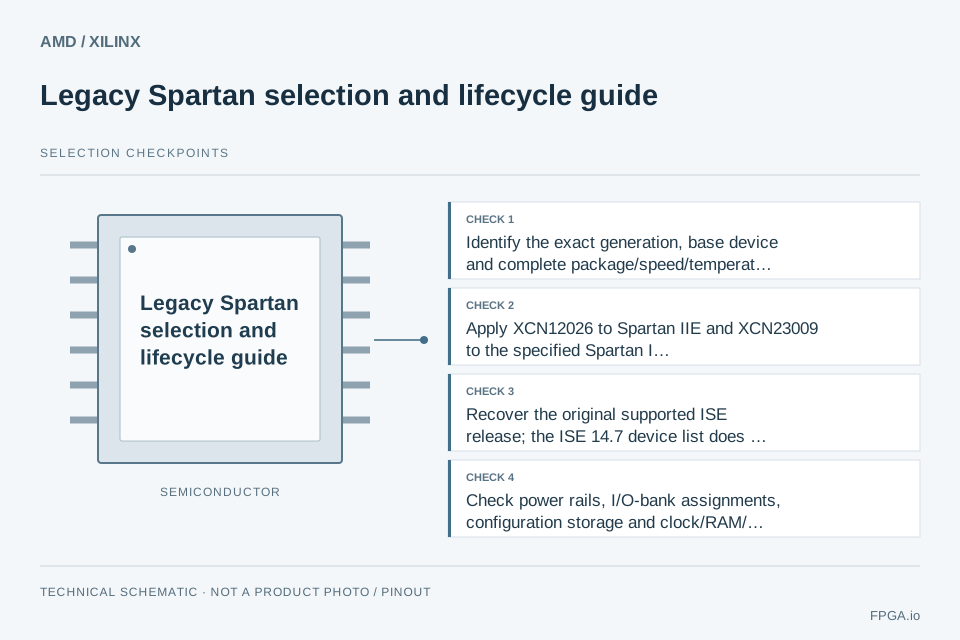
The ISE 14.7 architecture table covers Spartan-3, 3E, 3A, 3AN and 3A DSP. Spartan-II and Spartan-IIE are absent from that table, so preserve and verify their earlier project tool version instead of assuming that the latest ISE installer covers them.
Sources: UG631 ↗ ISE-DOWNLOAD ↗ UG1227 ↗ UG911-IMPORT ↗
XCN23009 covers listed XC/XA Spartan-II and Spartan-3/3E/3A/3AN/3A DSP device/packages, including the specified grades and SCD variants. It set final orders for 29 June 2024 and final deliveries for 28 December 2024, and must be read with earlier notices. Spartan-IIE is separately obsolete under XCN12026, with final orders on 31 May 2013 and final deliveries by 30 September 2014.
Sources: XCN23009 ↗ XCN12026 ↗ DS077 ↗
Treat this as an engineering checklist derived from the cited manuals. A successful rebuild of the old project provides the reference for validating a new device.
Sources: UG631 ↗ DS001 ↗ DS077 ↗ DS099 ↗ DS312 ↗ DS529 ↗ DS557 ↗ DS610 ↗ UG911-IMPORT ↗ UG911-CONSTRAINTS ↗ UG911-MAPPING ↗
ENGINEERING DECISIONS
Use these checks to define the requirement. Family names alone do not establish performance, package compatibility or current availability.
Identify the complete manufacturer part number, package, operating grade and electrical requirements. Reviewed FPGA specifications can then be compared at device level.
Browse reviewed FPGA device data →Bring the BOM, schematic constraints, stack-up and assembly requirements into the project brief.
PCBA project preparation →EVIDENCE & DEVELOPMENT
Start with the device table, then check electrical limits, ordering information and the applicable tool release.
Compare FPGA architecture generations and find automotive, defense, and space-grade branches.
Official resource and package tables for 7 Series device selection.
Official UltraScale device and package comparison tables.
Check the precise resource, package, and connectivity combinations in UltraScale+ FPGAs.
Task-oriented documentation entry points for architecture, design, verification, and implementation.
Discover additional AMD and partner boards by device family.
Official guide to VCK190, VMK180, VPK180, VPK120, VHK158, VEK280, and VEK385 platforms.
K24-based motor-control and DSP development platform.
K26-based entry point for vision application development.
K26-based robotics and industrial development platform.
Separate Ryzen AI Embedded-based platform for autonomous robotics.
Application-specific cards and solutions for telecommunications acceleration.
Space-grade product information; qualification and radiation requirements need exact-device review.
Soft-processor resources for embedding control software in programmable logic.
Current deployment guidance, board targets, and links to legacy DPU documentation.
Check device and feature entitlements, including the licensing changes introduced with 2026.1.
AMD's official discontinuation notice for the Versal HBM lineage.
XCN23009 covers specified XC9500XL, CoolRunner, Spartan II, and Spartan 3 product families.
Read AMD's family-level longevity statements and the explicit exclusions for integrated-HBM devices.
Search official support answers, knowledge-base articles, and community discussions.
These broader manufacturer resources do not establish support or compatibility for every device on this page.
PRACTICAL QUESTIONS
No. It identifies the base device. The full ordering code also specifies the speed grade, package and temperature range; verify those fields in DS312 before matching a BOM.
Sources: DS312 ↗
Some corresponding packages have pin compatibility, but Spartan-3AN integrates configuration flash. A 3A replacement needs an external configuration source and a review of boot connections and power requirements.
Spartan-3 devices use the ISE flow. Moving to Vivado requires a supported target device and porting the design and constraints; legacy project import alone does not establish device support.
Sources: UG631 ↗ UG911-IMPORT ↗
No. DS610 lists 519 maximum user I/O for XC3SD1800A and 469 for XC3SD3400A. Check the package table for the actual number available to the board.
Sources: DS610 ↗
No. They document device resources and primary references. Lifecycle is governed by the applicable notice, while remaining inventory requires separate verification for the complete ordering code.
Sources: XCN23009 ↗ XCN12026 ↗
They use different core voltages and I/O features. Their lifecycle evidence also differs: DS077 marks Spartan-IIE obsolete under XCN12026, whereas listed Spartan-II products appear in XCN23009.
Sources: DS001 ↗ DS077 ↗ XCN12026 ↗ XCN23009 ↗
A base-device identifier identifies the silicon or model, but may omit package, speed, temperature, qualification and packing options. Use the manufacturer ordering table to establish the complete code. Reference examples do not establish stock or an approved replacement.
A shared family or manufacturer does not establish pin compatibility. Compare pinout, supply and I/O-bank voltages, configuration, timing, tool support and thermal limits before changing a board.
Provide the exact part or board revision, quantity, delivery requirement, operating environment and traceability needs. For assembly, identify BOM readiness, PCB stack-up, programming access and the inspection or functional-test scope.
PREPARE A USEFUL INQUIRY
Select the points you want our team to review. Your selections stay in this browser until you choose to submit the quotation form.
Open quotation form →AMD / Xilinx Legacy Spartan selection and lifecycle guide reference ↗
Source review: 2026-09-28. This family guide does not assert stock or compatibility between devices.
← Complete AMD / Xilinx product map