
How this works
Blocks = ceil(requested width / primitive width) × ceil(requested depth / primitive depth). Unused bits = allocated capacity − payload capacity.
FPGA selection / T009
Estimate the block-count lower bound for a legal memory primitive configuration.
FBG676 · quantity not entered · service Electronic component sourcing. Return to the device evidence. This context is retained when you choose the enquiry form; it is not a completed device review.
01 / DEFINE THE REQUIREMENT
02 / REVIEW THE OUTPUT
Ready for an example run. Check the inputs, then run the tool.
Block-count lower bound and unused bit capacity
The report records the tool version and calculation time. Project enquiry opens a separate form for your review; it does not submit automatically.
03 / METHOD & VERIFICATION
Method version 1 · 2026-09-27
FPGA.io planning aid. Arithmetic and checklist output do not replace device documentation, a design tool or engineering approval.
Blocks = ceil(requested width / primitive width) × ceil(requested depth / primitive depth). Unused bits = allocated capacity − payload capacity.
Widths 1–1,000,000 bits; depths 1–1,000,000,000 words; exact-integer limit enforced. Supply a legal vendor primitive mode for the chosen port arrangement.
36 × 1024 payload with an 18 × 1024 primitive mode → 2 blocks, 0 unused bits.
Use the example inputs to inspect how the method behaves. This is a reference calculation, not a hardware test.
Calculations and pasted lists stay in this browser. No account is required. An enquiry brief is stored temporarily in this tab's session only when you choose to transfer it.
Report a method or input issue →04 / CONTINUE THE TASK
Keep exact device and board revisions with the assumptions you just checked.
Continue the task with the relevant source scope. These reading paths do not establish interchangeability or current supply.
Related fpga reading and planning context; not a compatibility recommendation.
Related fpga reading and planning context; not a compatibility recommendation.
Related fpga reading and planning context; not a compatibility recommendation.
Related fpga reading and planning context; not a compatibility recommendation.
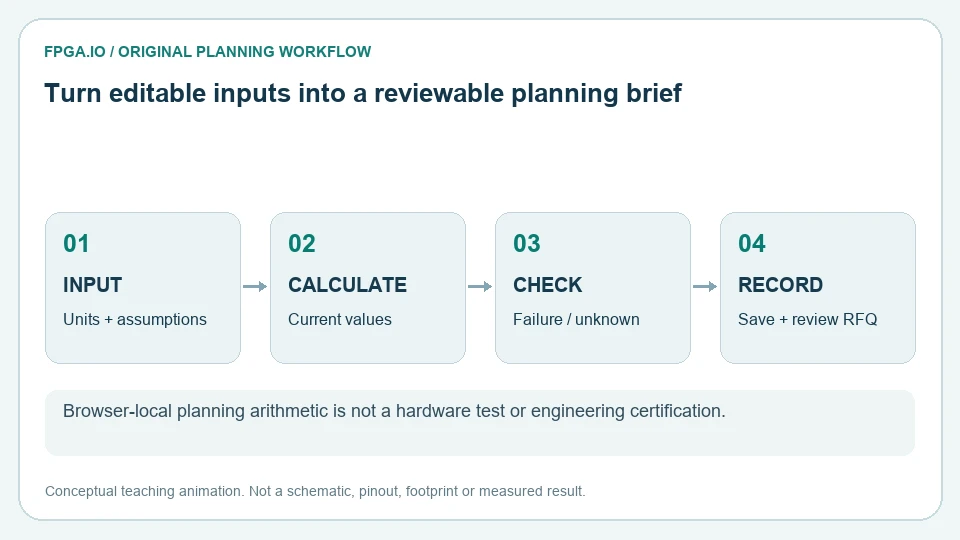
Turn editable inputs into a reviewable planning brief · Browser-local planning arithmetic is not a hardware test or engineering certification.
Original conceptual teaching visual. Not a product photograph, schematic, pinout, footprint or measured result. The static poster is used when reduced motion is requested.