
BASE DEVICE
LFMNX-50
Mach-NX secure-control FPGA with user logic and a secure enclave.
- User logic cells
- 8400
- EBR SRAM
- 432 kbit
- Distributed RAM
- 73 kbit
2 ordering codesLFMNX-50-5FBG484C →LFMNX-50-5FBG484I →
Specifications & documents →Lattice Semiconductor / Chips & IP
Match nonvolatile startup, board-management I/O and hardware security to the platform's requirements.
Product lines are representative. Stock, lifecycle, package and grade must be checked against the exact MPN.
FROM FAMILY TO DEVICE
Base-device names are distinct from full ordering numbers. Each detail page identifies the product type, parameter scope and official source.
BASE DEVICE
Mach-NX secure-control FPGA with user logic and a secure enclave.
BASE DEVICE
MachXO4 programmable control device.
BASE DEVICE
MachXO4 programmable control device.
BASE DEVICE
MachXO5-NX control FPGA base device.
BASE DEVICE
MachXO5-NX control FPGA base device.
BASE DEVICE
MachXO3D secure programmable device.
BASE DEVICE
MachXO3D secure programmable device.
BASE DEVICE
MachXO3LF programmable logic device with user flash.
BASE DEVICE
MachXO3LF programmable logic device with user flash.
BASE DEVICE
Mach-N2 secure-control FPGA device as named in the official selector.
BASE DEVICE
Mach-N2 secure-control FPGA device as named in the official selector.
BASE DEVICE
MachXO2 base device as named in the official selector.
BASE DEVICE
MachXO2 base device as named in the official selector.
13 device references
No model matches this search. Clear the filter or send the exact part number for review.
Browse the full Lattice Semiconductor product map →
WITHIN THIS PRODUCT LINE
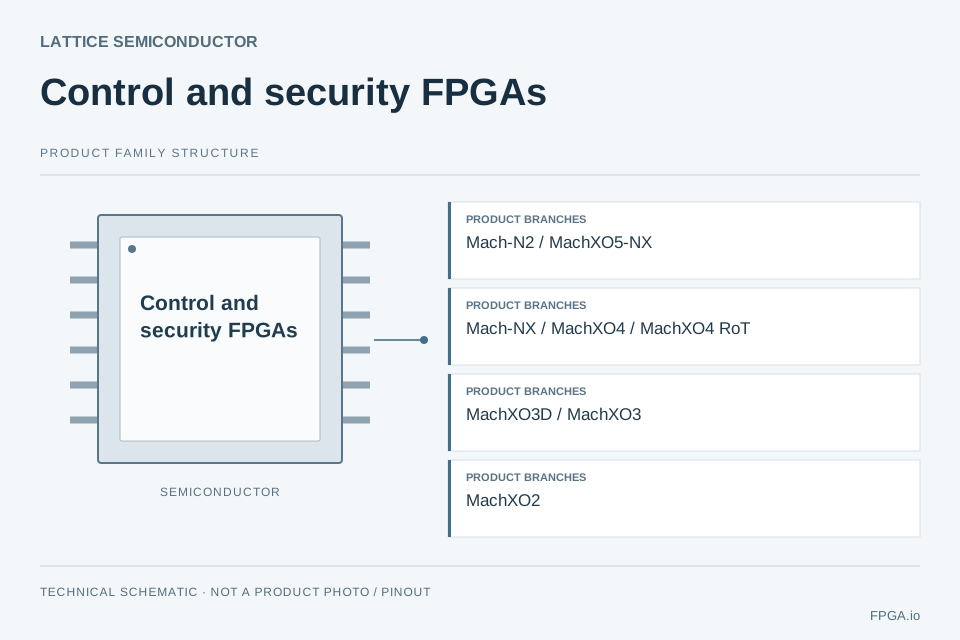
Nexus 2 control FPGA family with integrated flash and hardware security functions, including post-quantum-oriented protection.
2 device refs · 0 ordering codesExplore Mach-N2 →Higher-density secure control FPGA family with embedded flash, programmable I/O and root-of-trust variants.
2 device refs · 1 ordering codesExplore MachXO5-NX →Control FPGA with a secure enclave for hardware root-of-trust and platform firmware protection.
1 device refs · 2 ordering codesExplore Mach-NX →Low-density nonvolatile control family; the RoT branch adds hardened cryptographic services.
2 device refs · 0 ordering codesExplore MachXO4 / MachXO4 RoT →Secure control FPGA based on the MachXO3 architecture, with an immutable security block and dual-boot flash.
2 device refs · 2 ordering codesExplore MachXO3D →Compact control and bridging FPGA family with multiple I/O banks and L/LF options.
2 device refs · 1 ordering codesExplore MachXO3 →Established nonvolatile logic for power-up control, bridging and I/O expansion.
2 device refs · 6 ordering codesExplore MachXO2 →SELECTION CONTEXT
Match nonvolatile startup, board-management I/O and hardware security to the platform's requirements.
Use the requirements below to decide which specification limits your design. A family name alone is not a purchasing specification.
Choose the complete device and ordering code before checking package pinout, power, electrical limits and operating grade. Keep family maxima separate from a selected device or package.
Open the manufacturer reference ↗ENGINEERING DECISIONS
Use these checks to define the requirement. Family names alone do not establish performance, package compatibility or current availability.
Identify the complete manufacturer part number, package, operating grade and electrical requirements. Reviewed FPGA specifications can then be compared at device level.
Browse reviewed FPGA device data →Bring the BOM, schematic constraints, stack-up and assembly requirements into the project brief.
PCBA project preparation →EVIDENCE & DEVELOPMENT
Start with the device table, then check electrical limits, ordering information and the applicable tool release.
Official family entry points and product-selector access.
Search official development platforms and supporting design files.
Review maturity, discontinuance notices and suggested newer families.
Software downloads, release notes and device-support documentation.
These broader manufacturer resources do not establish support or compatibility for every device on this page.
PRACTICAL QUESTIONS
Start with the documented product scope: Match nonvolatile startup, board-management I/O and hardware security to the platform's requirements. Then compare the device-specific facts below with your required resources and interfaces. Open each model for its evidence and ordering constraints.
A base-device identifier identifies the silicon or model, but may omit package, speed, temperature, qualification and packing options. Use the manufacturer ordering table to establish the complete code. Reference examples do not establish stock or an approved replacement.
A shared family or manufacturer does not establish pin compatibility. Compare pinout, supply and I/O-bank voltages, configuration, timing, tool support and thermal limits before changing a board.
Provide the exact part or board revision, quantity, delivery requirement, operating environment and traceability needs. For assembly, identify BOM readiness, PCB stack-up, programming access and the inspection or functional-test scope.
PREPARE A USEFUL INQUIRY
Select the points you want our team to review. Your selections stay in this browser until you choose to submit the quotation form.
Open quotation form →Lattice Semiconductor Control and security FPGAs reference ↗
Source review: 2026-09-28. This family guide does not assert stock or compatibility between devices.
← Complete Lattice Semiconductor product map