
Industry Insights
XC7A200T-1FBG484C vs XC7A200T-1FBG484I: What a Buyer Must Confirm
FPGA.io editorial · AI-assisted preparation and review; not human engineering certification.
Published · Updated
XC7A200T-1FBG484C and XC7A200T-1FBG484I differ in the documented operating junction-temperature grade. For these commercial and industrial grades, AMD DS181 gives 0 to +85 °C and −40 to +100 °C respectively. Both codes retain the same base device, speed designation and package code. That makes them a useful comparison, but it does not make an offer for one automatically acceptable against a purchase order for the other.
This guide is for a buyer, maintenance engineer or junior designer who has a real order code and needs to decide what to ask next. The output is a short change-review brief, with temperature, source identity and supply evidence kept separate. It is not a claim that either part is currently available, a recommendation to substitute a commercial part, or a report of testing an industrial assembly. The operating-temperature exercise below uses hypothetical requirements, not a customer's equipment.
The last letter is a requirement, not a cosmetic suffix
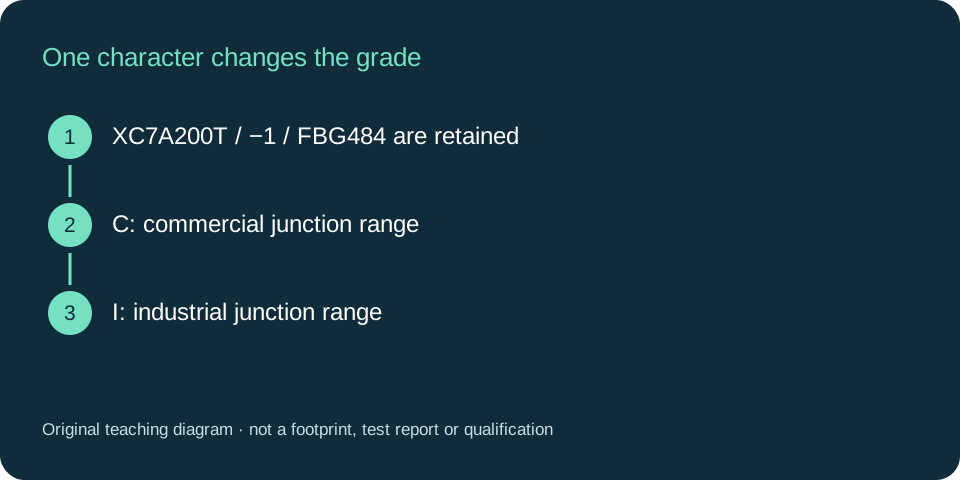
Start by copying the complete manufacturer part number from the released BOM. Do not shorten it to XC7A200T, Artix-7 or FBG484 in the quotation request. Those fragments describe useful portions of the requirement but cannot identify the requested grade. Preserve the punctuation and suffix in the supplier's response, the internal comparison and the final order line. A single unrecorded letter change can become an undocumented BOM change even when the price comparison looks straightforward.
The commercial XC7A200T-1FBG484C reference and industrial XC7A200T-1FBG484I reference retain package-specific facts and their sources. Read the source conditions rather than treating two matching table cells as a complete approval. The FBG484 package references describe geometry; the speed designation directs the timing review; the grade conditions direct the operating-envelope review. These pieces belong together, but they answer different questions.
Make the first purchase decision explicit: is the original MPN mandatory, or may the supplier suggest candidates for a named engineering owner to review? When the BOM is frozen for a regulated, contract-controlled or internally qualified product, purchasing should not infer permission from a similar code. Equally, an engineer should not assume that a wider catalogue temperature range resolves supplier provenance or the customer's change-control requirements. Those are independent decisions with different records.
A useful receiving instruction is to reconcile the offered manufacturer code, purchase-order code and supplier documentation before acceptance. That reconciliation is an identity check, not an authentication method. Photographs and markings can support an investigation, but they do not by themselves establish the origin, storage history or electrical condition of a lot. Ask the responsible quality team which evidence and inspection scope the particular purchase requires.
Junction temperature is not the air temperature around the board
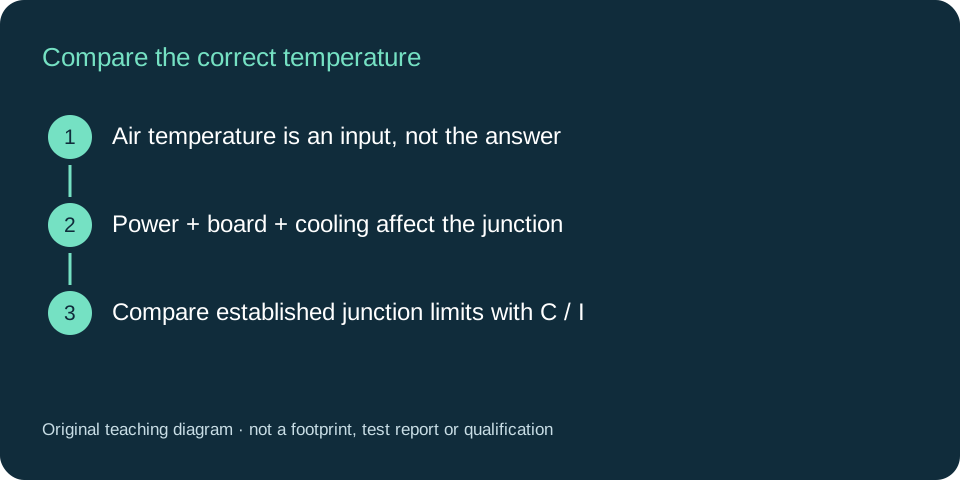
The temperature intervals above apply to the semiconductor junction under the datasheet's operating conditions. They are not an ambient rating for every enclosure or assembled board. A room measured at 40 °C does not establish that the FPGA junction stays below 85 °C. Device activity, rail settings, airflow, heatsinking, neighboring heat sources and the actual board construction affect the result. The design owner needs an appropriate thermal analysis and verification plan for the assembly.
Consider a hypothetical design requirement of −20 to +90 °C at the junction. The commercial interval fails both ends of that stated requirement, while the industrial interval contains it. This comparison is useful because it identifies an obvious grade mismatch early. It still does not prove that the device is suitable for the application. The same design may fail timing, I/O-voltage, power sequencing or another requirement that the interval exercise never examines.
Now consider an operating estimate of +10 to +70 °C. Both listed intervals contain those numbers. That result says only that this particular numerical comparison has not found a temperature-interval mismatch. It does not cancel an industrial-grade requirement already imposed by the customer, the qualification file or the approved BOM. Nor does it establish a safety margin: estimates and measurements have uncertainty, and the actual worst case may not have been captured.
Use the worksheet to identify which interval contains a proposed junction requirement. Leave the requirement unresolved if you have only ambient values. The tool intentionally reports a narrow result; it cannot translate an enclosure temperature into junction temperature or approve a change. Retain the assumptions and hand the result to the person responsible for the thermal design.
Without JavaScript: compare the required minimum and maximum junction temperatures with C: 0…85 °C and I: −40…100 °C. An interval match is not a full device or board qualification.
AMD DS181, Artix-7 DC and AC Switching Characteristics, v1.27.1, Table 2 on pages 2–3, is the original reference for the operating conditions used here. Table 1 contains absolute maximum ratings and serves a different purpose. Do not select an operating point by treating an absolute maximum as a normal continuous-use target.
What the shared FBG484 label does—and does not—settle
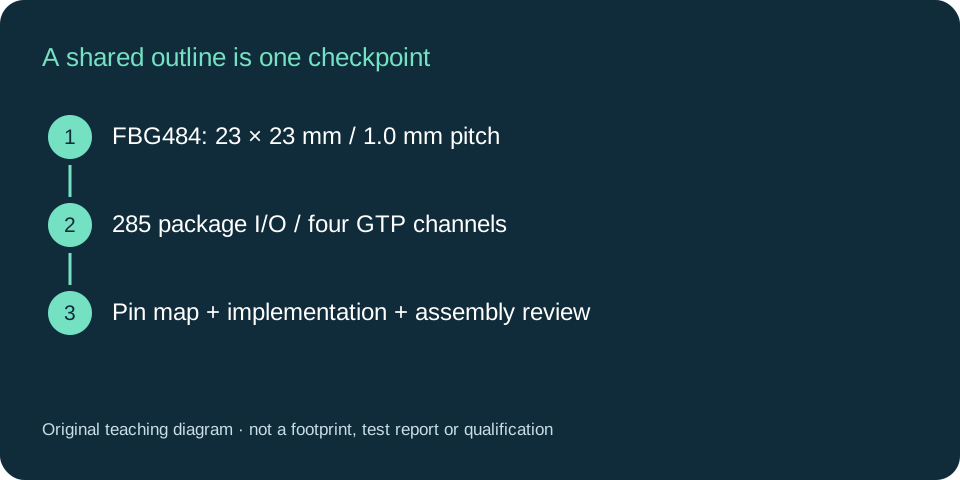
The reviewed FBG484 implementation provides 285 user I/O and four GTP channels for this device. These counts describe a package resource envelope. They do not tell a buyer which signals the existing board actually uses, which banks share a rail, or whether a proposed configuration meets the application. Obtain the approved pin constraints and the relevant package documentation when any part change is proposed. A package label is not a substitute for those records.
The mechanical reference describes FBG484 as a 23 × 23 mm package with 1.0 mm pitch. That is enough to distinguish it from many other package choices, but it is not a fabrication-ready footprint. Ball positions, tolerances, package drawing revisions and board land-pattern decisions need their own review. A drawing copied from a visually similar part can preserve an outline while losing details that matter to routing or assembly.
Consult AMD UG475, 7 Series Packaging and Pinout together with the device/package table in AMD DS180, 7 Series Overview. Record the revision used by your review. The FPGA.io page is a navigation aid that brings scoped facts together; the manufacturer material and your released project remain the evidence for a board decision.
Also keep the timing and programming work visible. The same printed speed numeral does not demonstrate that a different build, tool version or operating condition has been validated. Identify the released implementation, timing constraints and programming artifact before accepting a candidate. For maintenance, the person who owns those files may be different from the buyer handling the shortage. Finding that owner early is often more valuable than expanding the candidate list.
A replacement-column appearance does not mean the part was discontinued
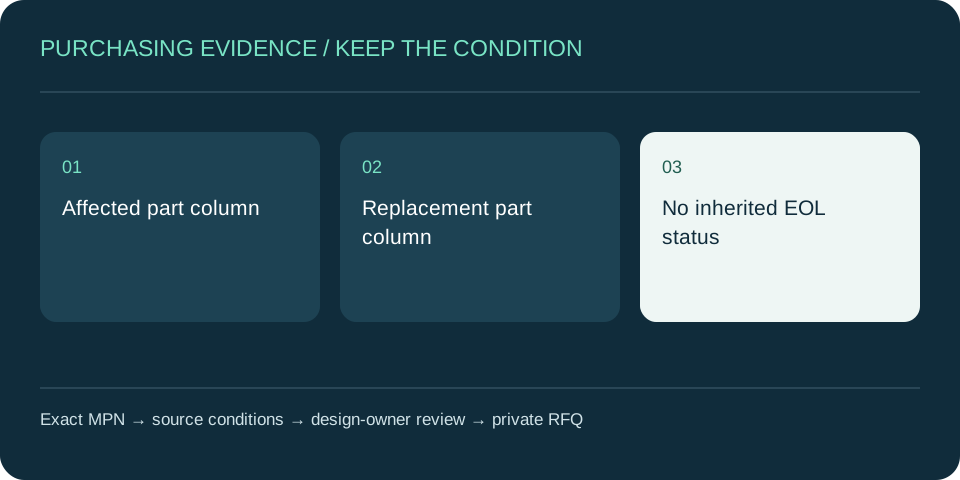
Xilinx XCN20011 v1.0, dated September 28, 2020, contains these exact FBG484 codes in the replacement column of Table 4 on page 2. The affected rows in that table use the corresponding FBV package codes. This is an important identity distinction: a search result containing an MPN and a discontinuation notice can look alarming while the MPN occupies a different role in the actual table.
The original XCN20011 manufacturer PDF was retrieved and its relevant table visually reviewed for this article. That establishes what the historical document says. It does not establish the current production status of every listed replacement, and it does not establish stock. Subsequent notices, current manufacturer information and an offer-specific supply review remain separate tasks.
Keep a small lifecycle record with the exact code, notice identifier, revision, page, table and column role. Add any last-order or final-shipment dates only when the source explicitly assigns them to that role. If a later source cannot be retrieved, record the access gap and preserve the earlier evidence date. Do not silently replace “unconfirmed now” with “active,” “obsolete” or “available.” Each of those labels needs support for its own meaning.
The notice-reading and replacement-qualification guide explains the three independent gates: identity/lifecycle, engineering change and the supply decision. Its worked example is useful when a purchasing spreadsheet currently has one overloaded “replacement approved” column. Split that column before the next supplier comparison so a historical relationship cannot masquerade as a board release.
Before closing the document review, ask a colleague to reproduce one row without relying on your conclusion. Give them the original PDF and the exact locator, then have them identify the code and column role. A disagreement often reveals a transposed column, a suffix lost during copying or a scope statement that was separated from its table. Resolve the discrepancy in the evidence record instead of choosing whichever interpretation makes sourcing easier.
Keep retrieval and revision dates distinct. A document downloaded today can still describe a 2020 event. Recording today's retrieval time helps show which file was used, while the original revision date explains the event's historical context. Neither date is a warranty that no later information exists. If the current decision requires present lifecycle confirmation, assign that additional check explicitly.
Compare the offer only after its scope matches the requirement
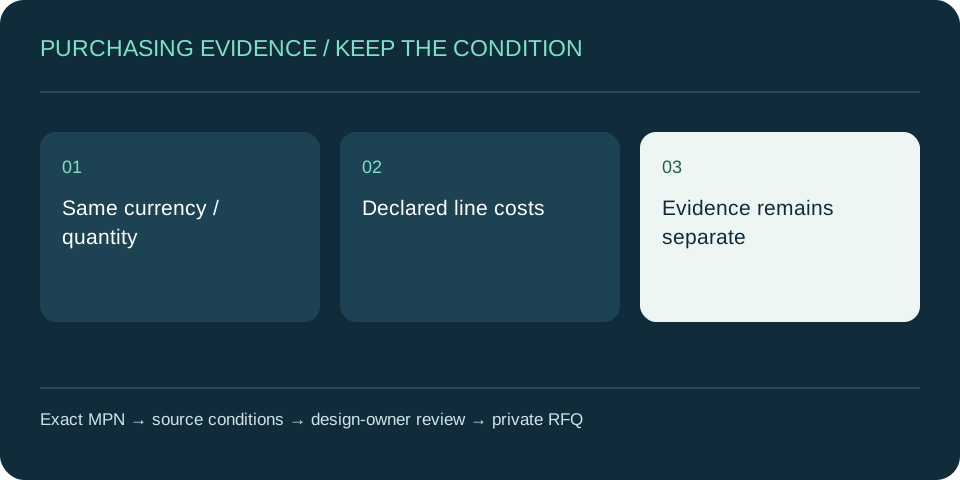
A lower unit price for the wrong grade is not a saving against an exact-grade requirement. First reconcile the full code, quantity, acceptable delivery splits and the permitted change scope. Then compare the commercial terms you actually received. An attractive figure on a catalogue page is not a current offer for a particular lot, destination and inspection requirement. Leave unavailable values blank instead of estimating a market price and presenting it as a quotation.
For a hypothetical request for 25 units, record whether each offer covers 25 usable units in one shipment or only a partial quantity. Record currency, unit price, freight and any separately quoted inspection cost. State which items are excluded, such as tax, duties, insurance or payment charges. Comparing two totals with different quantities or currencies without conversion assumptions hides a scope difference rather than resolving it.
Keep provenance and acceptance evidence beside the commercial comparison, not inside an unexplained numerical score. A supplier's document package, lot traceability and agreed inspection scope should be evaluated by the responsible people against the purchase requirements. This guide does not certify a supplier or prescribe a universal test regime. The right scope depends on the intended use, risk tolerance, customer obligations and what evidence can actually be obtained.
When a critical item remains unanswered, write a specific question for the supplier or design owner. “Please confirm the exact manufacturer order code on the offered documentation” is actionable. “Please confirm compatibility” is usually too broad unless the application, comparison criteria and approving authority are stated. The shortage-review workflow helps preserve that distinction before an enquiry is submitted.
Finish with a purchasing brief another person can act on
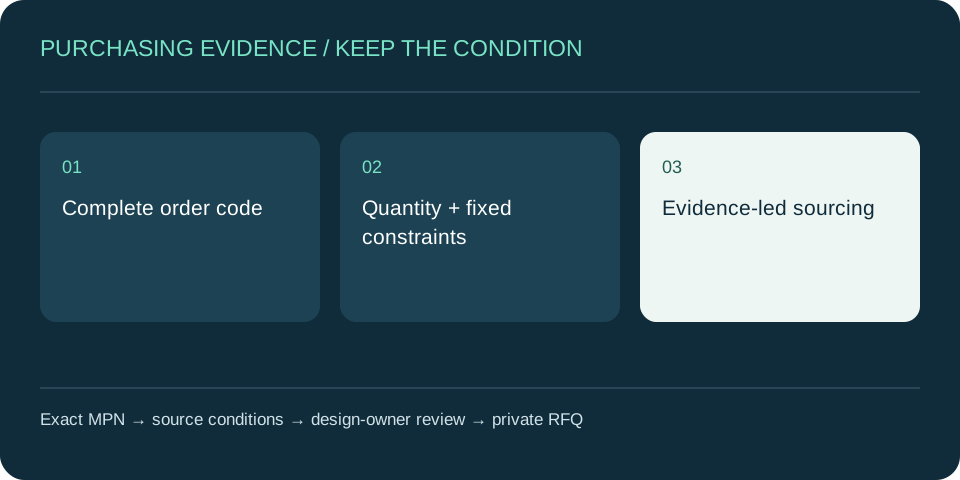
A useful handoff identifies the required MPN, the actual component quantity, the required delivery window, the destination and whether alternatives may be suggested. It also names the board revision and the decision owner when an engineering change is possible. These inputs let the sourcing conversation start with a concrete requirement instead of a vague request for “an Artix replacement.” They do not obligate you to accept a candidate or authorize an unreviewed substitution.
Attach the evidence record that matters to the unresolved decision. For this pair, that may be the junction-temperature requirement and the original datasheet row. If a package or device change is also being proposed, the necessary record becomes broader: pin use, rail conditions, implementation constraints and an agreed validation plan. The PCB bring-up checklist can help organize later validation checkpoints, but planning a test is not evidence that it passed.
If the original board cannot be sustained, separate the component enquiry from a board assembly or redesign scope. A request for 25 components is not automatically a request for 25 assembled boards, and neither establishes the quantity of every BOM line. Keeping the scopes distinct avoids accidental commercial assumptions while preserving a route to a broader project when the engineering evidence supports it.
Prepare an industrial-part enquiry with 25 units or prepare a separately scoped 10-board project enquiry. These are editable examples. Review the quantity and add confidential requirements in the private form before submitting.
AI-assisted documentary and editorial review. No human engineering certification, current stock, guaranteed delivery or application qualification is asserted.
Open the animated steps; close to hide motion
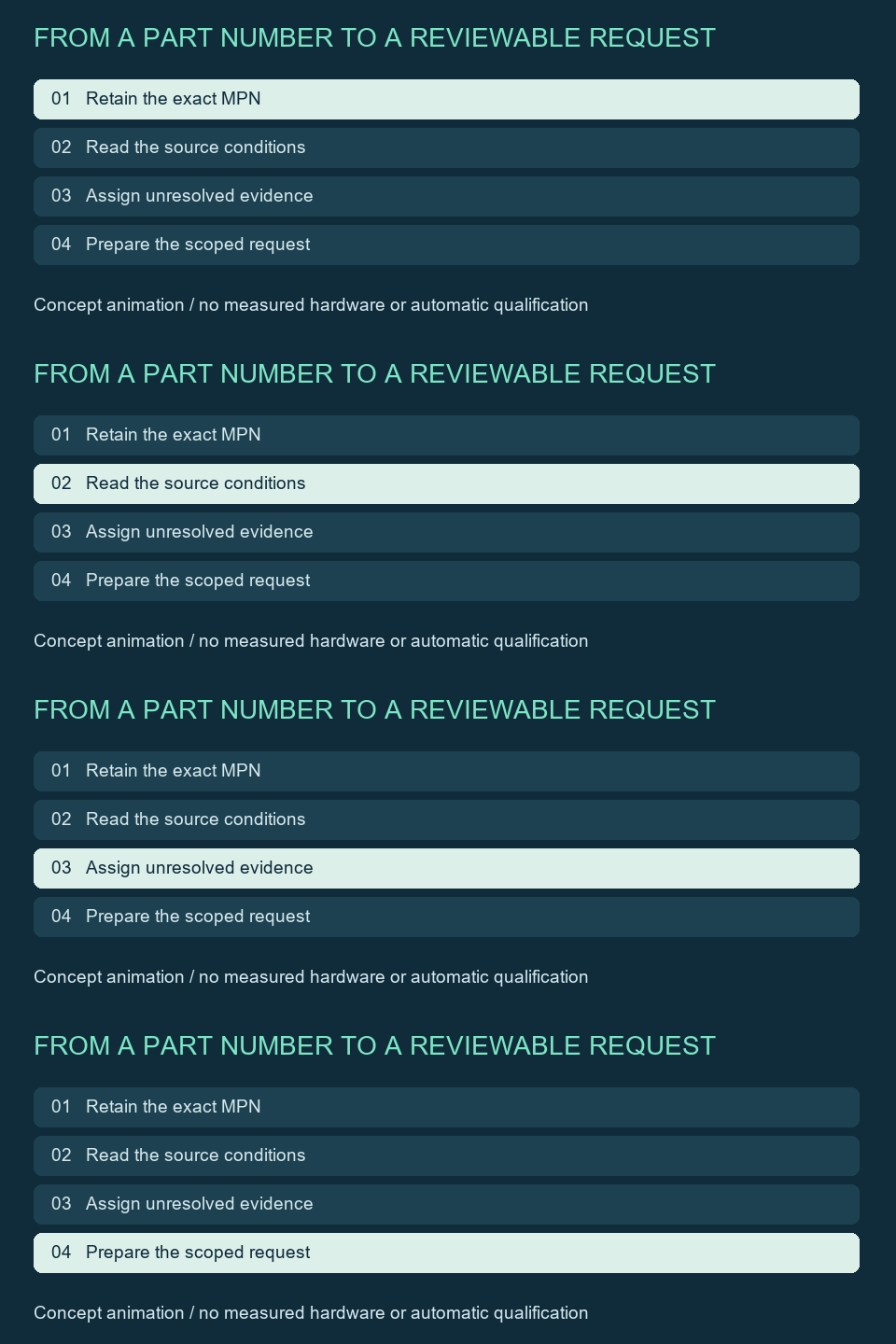
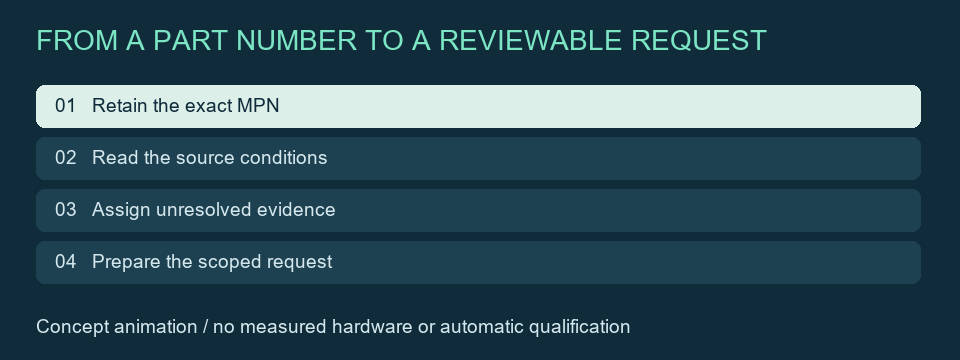
- Retain the exact manufacturer ordering code.
- Record the source revision and operating conditions.
- Assign unresolved evidence to its owner.
- Prepare an exact request or separately authorized change review.